
ASTM C1138M-12
 Preview
Summary
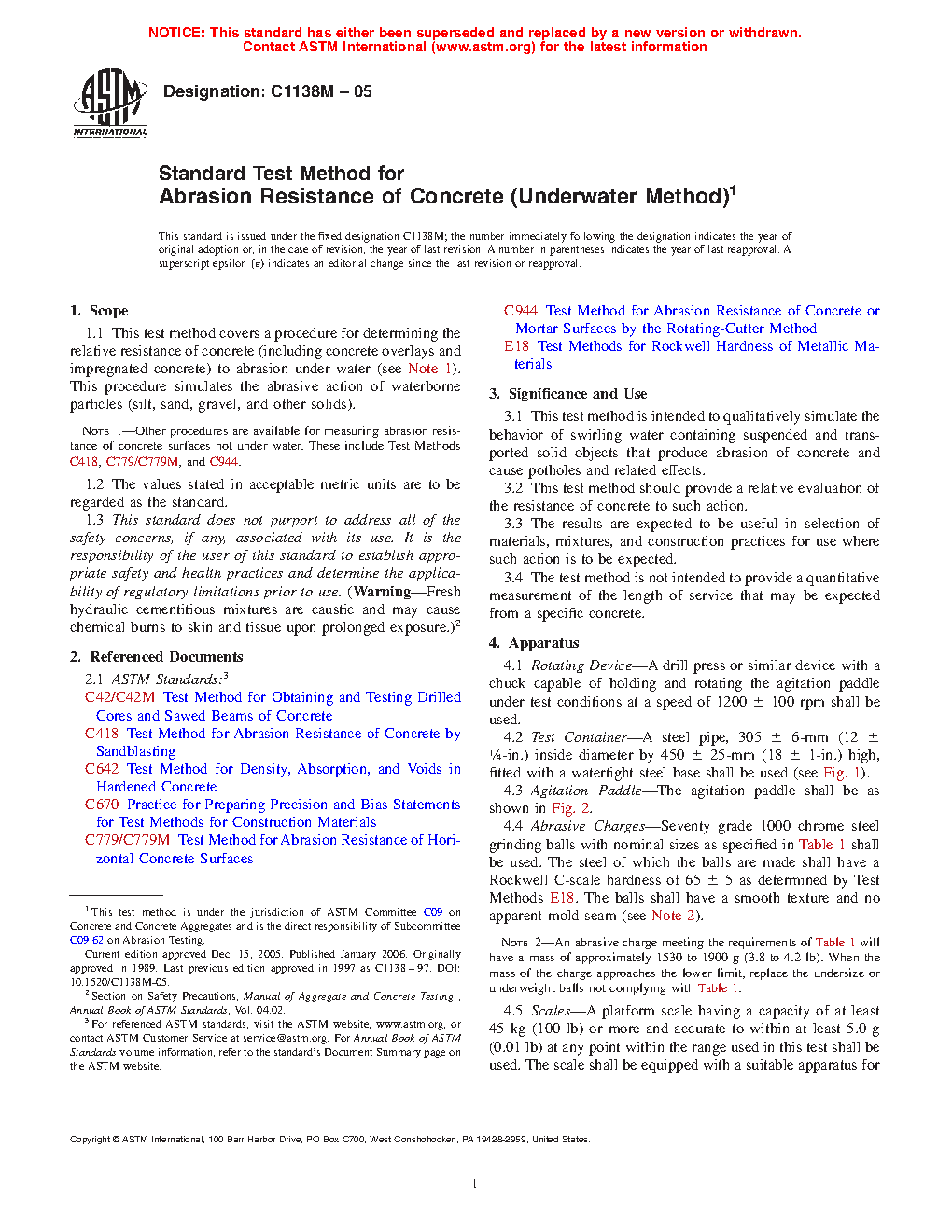
1.1 This test method covers a procedure for determining the relative resistance of concrete (including concrete overlays and impregnated concrete) to abrasion under water (see Note 1). This procedure simulates the abrasive action of waterborne particles (silt, sand, gravel, and other solids).
1.2 The values stated in SI units are to be regarded as standard. No other units of measurement are included in this standard.
1.3 This standard does not purport to address all of the safety concerns, if any, associated with its use. It is the responsibility of the user of this standard to establish appropriate safety and health practices and determine the applicability of regulatory limitations prior to use. (Warning—Fresh hydraulic cementitious mixtures are caustic and may cause chemical burns to skin and tissue upon prolonged exposure.)2
Significance and Use:
4.1 This test method is intended to qualitatively simulate the behavior of swirling water containing suspended and transported solid objects that produce abrasion of concrete and cause potholes and related effects.
4.2 This test method should provide a relative evaluation of the resistance of concrete to such action.
Technical characteristics
| Publisher | American Society for Testing and Materials (ASTM International) |
| Publication Date | 12/01/2012 |
| Collection | |
| Page Count | 5 |
| Themes | Concrete structures |
| EAN | --- |
| ISBN | --- |
| Weight (in grams) | --- |
Replaces

Previous versions