
ASTM C25-24
 Preview
Summary
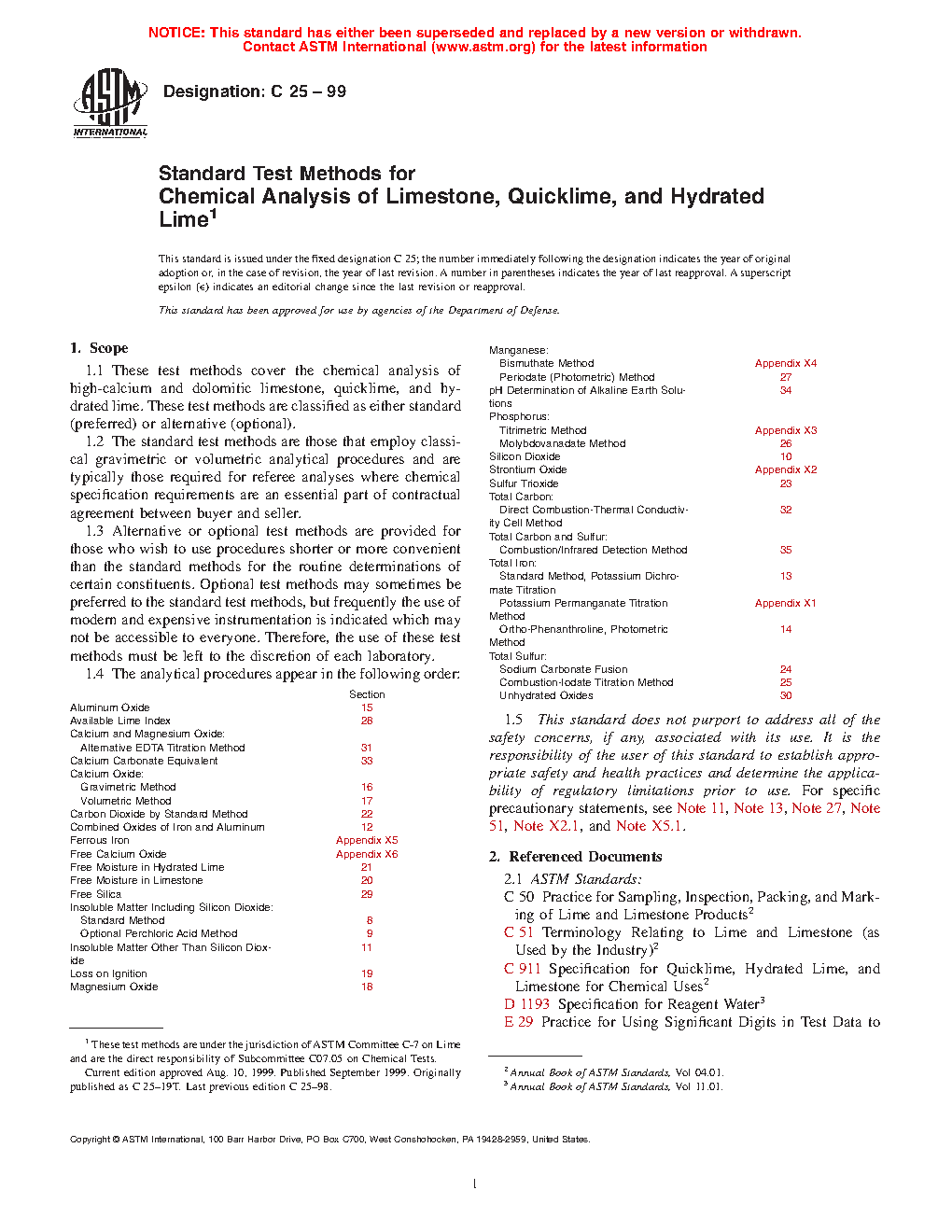
1.1 These test methods cover the chemical analysis of high-calcium and dolomitic limestone, quicklime, and hydrated lime. These test methods are classified as either standard (preferred) or alternative (optional).
1.2 The standard test methods are those that employ classical gravimetric or volumetric analytical procedures and are typically those required for referee analyses where chemical specification requirements are an essential part of contractual agreement between buyer and seller.
1.3 Alternative or optional test methods are provided for those who wish to use procedures shorter or more convenient than the standard methods for the routine determinations of certain constituents. Optional test methods may sometimes be preferred to the standard test methods, but frequently the use of modern and expensive instrumentation is indicated which may not be accessible to everyone. Therefore, the use of these test methods must be left to the discretion of each laboratory.
1.4 The analytical procedures appear in the following order:
|
| Section |
| Aluminum Oxide | 15 |
| Available Lime Index | 28 |
| Calcium and Magnesium Oxide: | |
| Alternative EDTA Titration Method | 31 |
| Calcium Carbonate Equivalent | 33 |
| Calcium Oxide: | |
| Gravimetric Method | 16 |
| Volumetric Method | 17 |
| Carbon Dioxide by Standard Method | 22 |
| Combined Oxides of Iron and Aluminum | 12 |
| Ferrous Iron | Appendix X5 |
| Free Calcium Oxide | Appendix X6 |
| Free Moisture in Hydrated Lime | 21 |
| Free Moisture in Limestone | 20 |
| Free Silica | 29 |
| Insoluble Matter Including Silicon Dioxide: | |
| Standard Method | 8 |
| Optional Perchloric Acid Method | 9 |
| Insoluble Matter Other Than Silicon Dioxide | 11 |
| Loss on Ignition | 19 |
| Magnesium Oxide | 18 |
| Manganese: | |
| Bismuthate Method | Appendix X4 |
| Periodate (Photometric) Method | 27 |
| pH Determination of Alkaline Earth Solutions | 34 |
| Phosphorus: | |
| Titrimetric Method | Appendix X3 |
| Molybdovanadate Method | 26 |
| Silicon Dioxide | 10 |
| Strontium Oxide | Appendix X2 |
| Sulfur Trioxide | 23 |
| Total Carbon: | |
| Direct Combustion-Thermal Conductivity Cell | 32 |
| Total Carbon and Sulfur: | |
| Combustion/Infrared Detection Method | 35 |
| Total Iron: | |
| Standard Method, Potassium Dichromate | 13 |
| Potassium Permanganate Titration Method | Appendix X1 |
| Ortho-Phenanthroline, Photometric Method | 14 |
| Total Sulfur: | |
| Sodium Carbonate Fusion | 24 |
| Combustion-Iodate Titration Method | 25 |
| Unhydrated Oxides | 30 |
1.5 This standard does not purport to address all of the safety concerns, if any, associated with its use. It is the responsibility of the user of this standard to establish appropriate safety, health, and environmental practices and determine the applicability of regulatory limitations prior to use.
For specific precautionary statements, see 9.3, 10.2.1, 18.4.3, 31.6.4.2, X2.3.1, and X5.4.1.1.
1.6 This international standard was developed in accordance with internationally recognized principles on standardization established in the Decision on Principles for the Development of International Standards, Guides and Recommendations issued by the World Trade Organization Technical Barriers to Trade (TBT) Committee.
Significance and Use:
4.1 These test methods provide accurate and reliable analytical procedures to determine the chemical constituents of limestone, quicklime, and hydrated lime (see Note 1). The percentages of specific constituents which determine a material's quality or fitness for use are of significance depending upon the purpose or end use of the material. Results obtained may be used in relation to specification requirements.
4.2 Because quicklime and hydrated lime quickly absorb water and carbon dioxide from the air, precision and bias are extremely dependent upon precautions taken during sample preparation and analysis to minimize excessive exposure to ambient conditions.
Note 1: These test methods can be applied to other calcareous materials if provisions are made to compensate for known interferences.
Technical characteristics
| Publisher | American Society for Testing and Materials (ASTM International) |
| Publication Date | 06/01/2024 |
| Collection | |
| Page Count | 40 |
| Themes | Mortar |
| EAN | --- |
| ISBN | --- |
| Weight (in grams) | --- |
Replaces

ASTM C25-19e1
Previous versions

ASTM C25-19e1


ASTM C25-11e1

ASTM C25-11e2