ASTM D143-94(2007)
 Preview
Summary
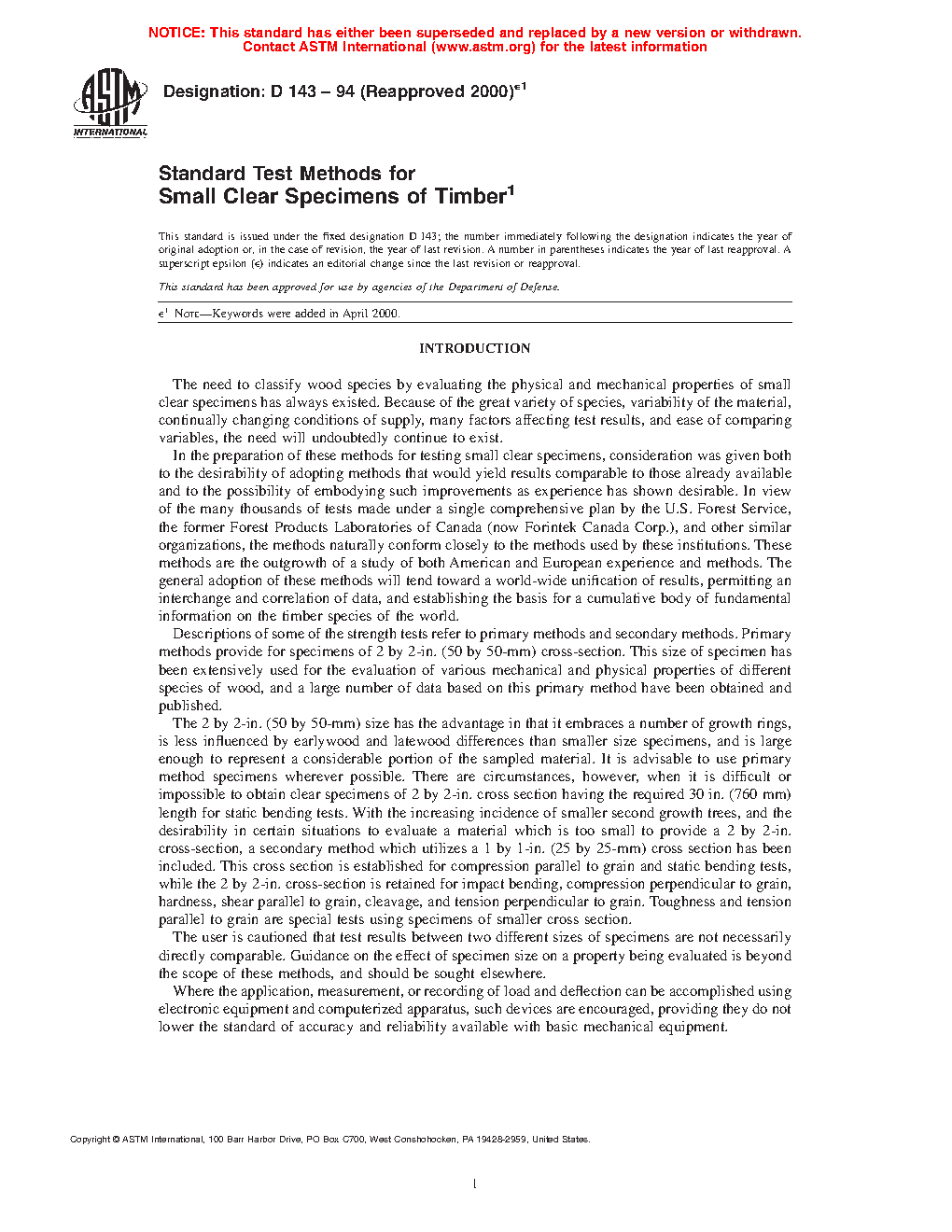
1.1 These methods cover the determination of various strength and related properties of wood by testing small clear specimens.
1.1.1 These methods represent procedures for evaluating the different mechanical and physical properties, controlling factors such as specimen size, moisture content, temperature, and rate of loading.
1.1.2 Sampling and collection of material is discussed in Practice D5536. Sample data, computation sheets, and cards have been incorporated, which were of assistance to the investigator in systematizing records.
1.1.3 The values stated in inch-pound units are to be regarded as the standard. The SI values are given in parentheses and are provided for information only. When a weight is prescribed, the basic inch-pound unit of weight (lbf) and the basic SI unit of mass (Kg) are cited.
1.2 The procedures for the various tests appear in the following order:
| Sections | |
| Photographs of Specimens | 5 |
| Control of Moisture Content and Temperature | 6 |
| Record of Heartwood and Sapwood | 7 |
| Static Bending | 8 |
| Compression Parallel to Grain | 9 |
| Impact Bending | 10 |
| Toughness | 11 |
| Compression Perpendicular to Grain | 12 |
| Hardness | 13 |
| Shear Parallel to Grain | 14 |
| Cleavage | 15 |
| Tension Parallel to Grain | 16 |
| Tension Perpendicular to Grain | 17 |
| Nail Withdrawal | 18 |
| Specific Gravity and Shrinkage in Volume | 19 |
| Radial and Tangential Shrinkage | 20 |
| Moisture Determination | 21 |
| Permissible Variations | 22 |
| Calibration | 23 |
1.3 This standard does not purport to address all of the safety concerns, if any, associated with its use. It is the responsibility of the user of this standard to establish appropriate safety and health practices and determine the applicability of regulatory limitations prior to use.
Significance and Use:
These methods cover tests on small clear specimens of wood that are made to provide the following:
4.1.1 Data for comparing the mechanical properties of various species,
4.1.2 Data for the establishment of correct strength functions, which in conjunction with results of tests of timbers in structural sizes (see Methods D 198
4.1.3 Data to determine the influence on the mechanical properties of such factors as density, locality of growth, position in cross section, height of timber in the tree, change of properties with seasoning or treatment with chemicals, and change from sapwood to heartwood.
Technical characteristics
| Publisher | American Society for Testing and Materials (ASTM International) |
| Publication Date | 01/01/2000 |
| Confirmation Date | 04/01/2007 |
| Collection | |
| Page Count | 32 |
| Themes | Wood, sawlogs and sawn timber |
| EAN | --- |
| ISBN | --- |
| Weight (in grams) | --- |
Replaces
Previous versions