

ASTM D4171-11
 Preview
Summary
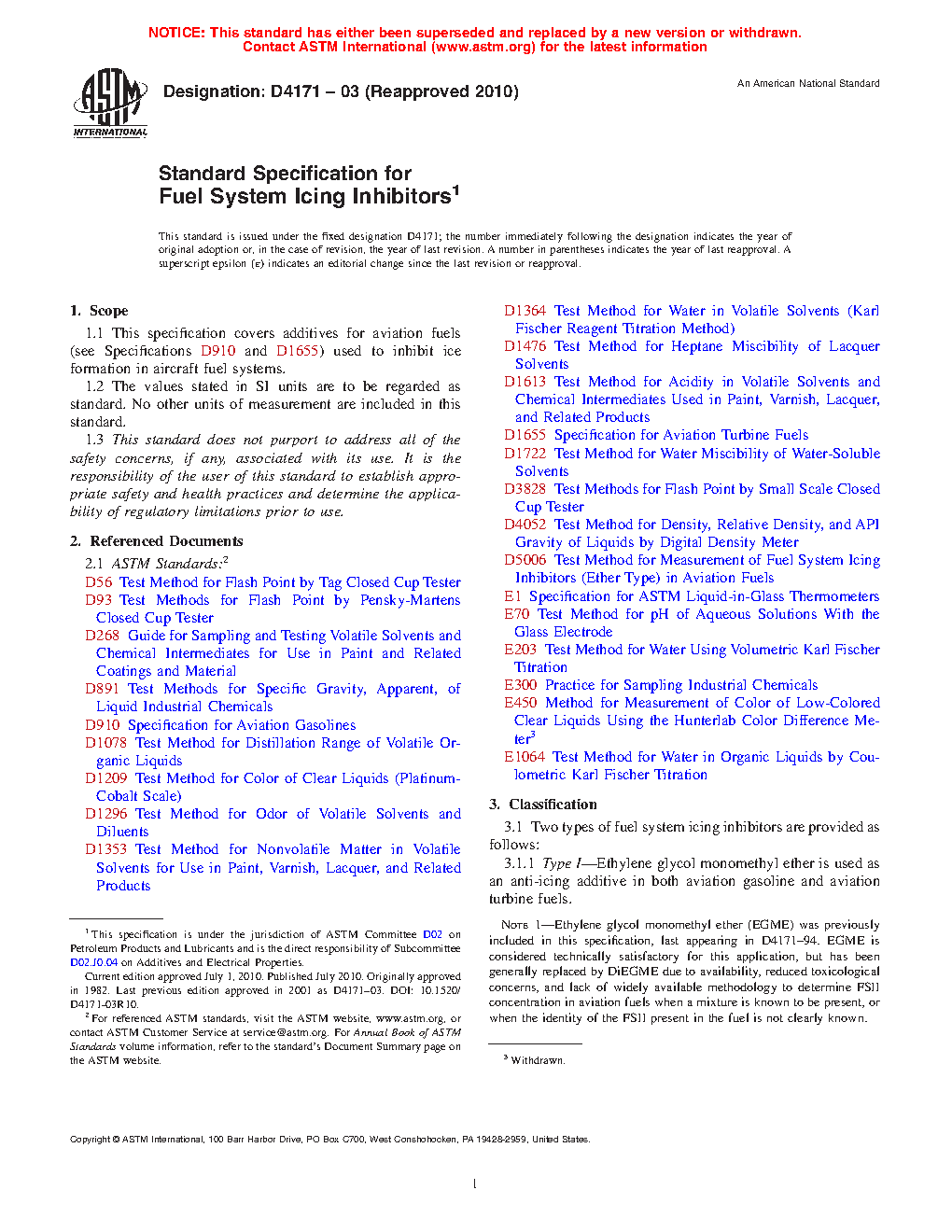
1.1 This specification covers additives for aviation fuels (see Specifications D910 and D1655) used to inhibit ice formation in aircraft fuel systems.
1.2 The values stated in SI units are to be regarded as standard. No other units of measurement are included in this standard.
1.3 WARNING
1.4 This standard does not purport to address all of the safety concerns, if any, associated with its use. It is the responsibility of the user of this standard to establish appropriate safety and health practices and determine the applicability of regulatory limitations prior to use.
Rationale:
This specification covers additives for aviation fuels used to inhibit ice formation in aircraft fuel systems. Three types of fuel system icing inhibitors are provided as follows: type I - ethylene glycol monomethyl ether, type II - anhydrous isopropanol, and type III - diethylene glycol monomethyl ether. The relative density, color, distillation range, non-volatile matter, and odor shall be tested to meet the requirements prescribed. The water properties, heptanes miscibility, acidity, water miscibility, and flash point shall be tested to meet the requirements prescribed.
Significance and Use:
A1.3.1 Fuel system icing inhibitor performance (Type III) is based upon test results using the pure inhibitor in a specific concentration range. Impurities affect inhibitor solubility in the fuel and reduce the effective concentration. Methods are therefore needed to check additive purity to ensure adequate performance in the aircraft.
Technical characteristics
| Publisher | American Society for Testing and Materials (ASTM International) |
| Publication Date | 05/01/2011 |
| Collection | |
| Page Count | 5 |
| Themes | Liquid fuels |
| EAN | --- |
| ISBN | --- |
| Weight (in grams) | --- |
Replaces
Previous versions


