
ASTM D4821-25
 Preview
Summary
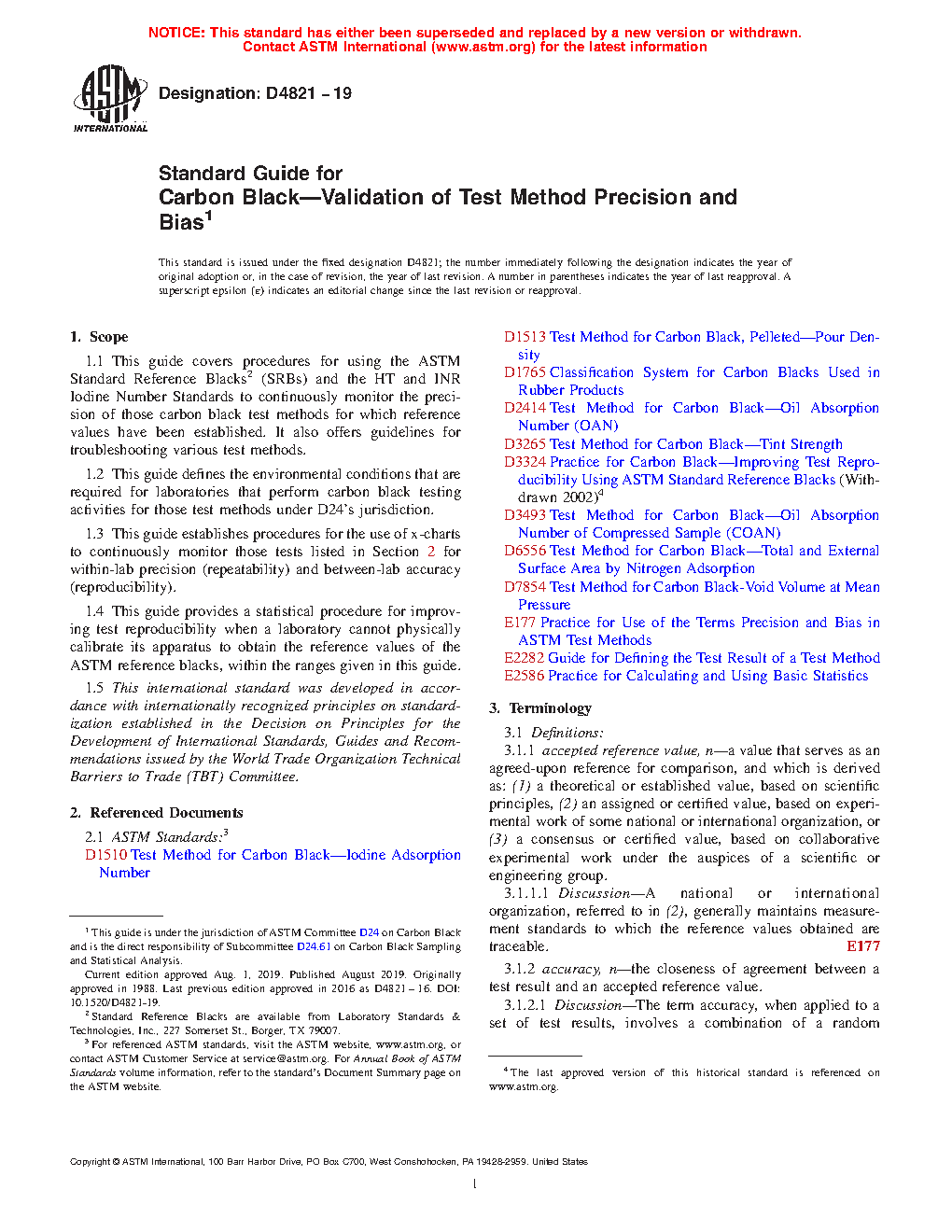
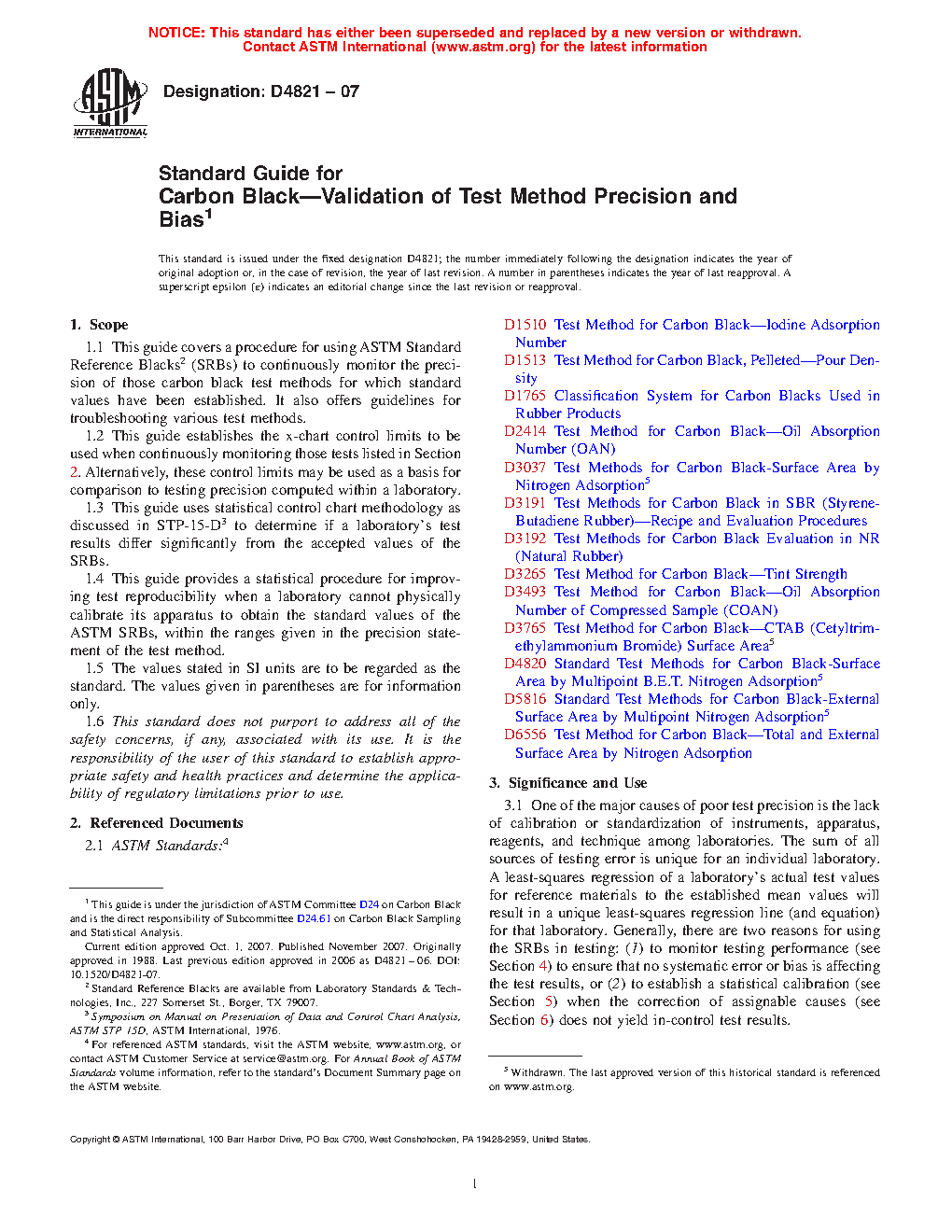
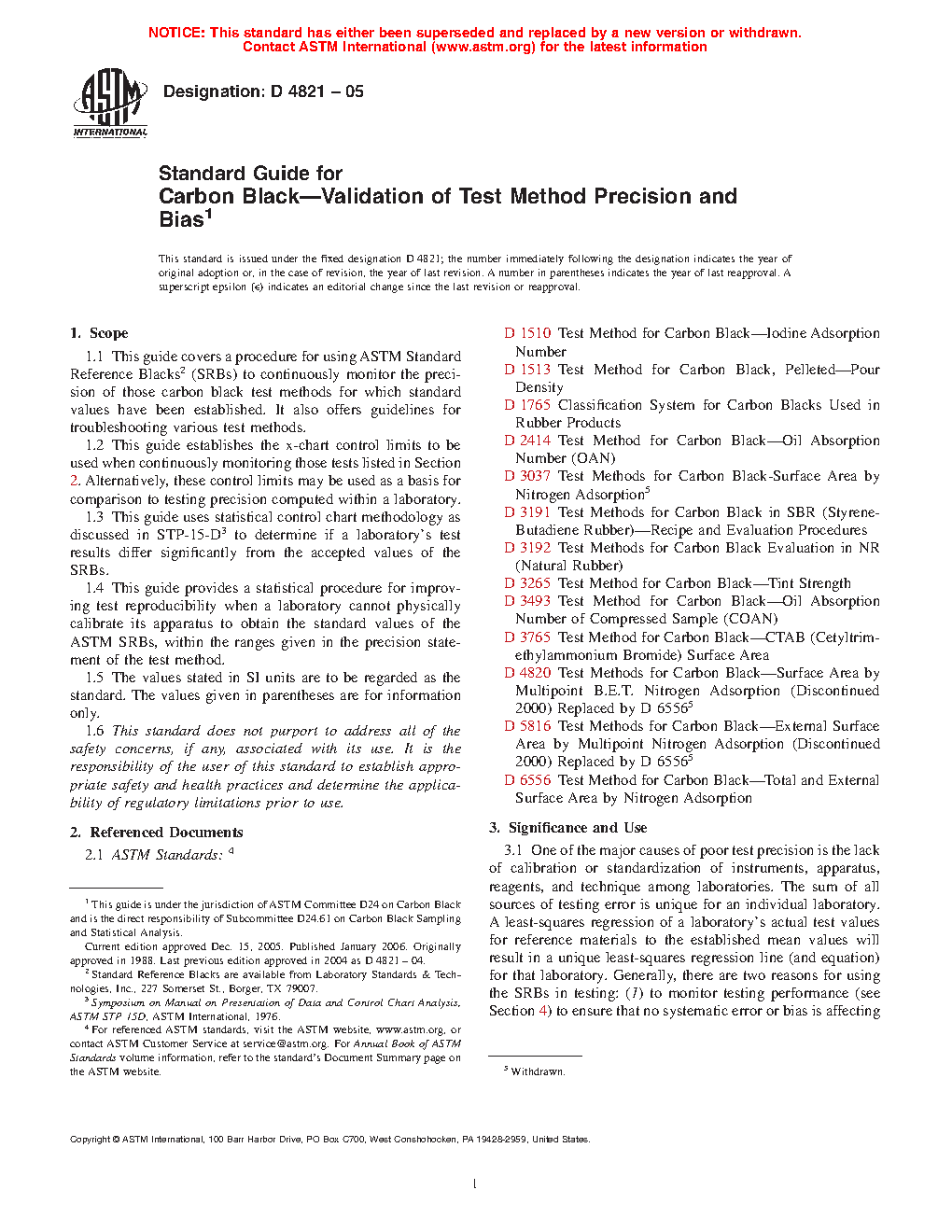
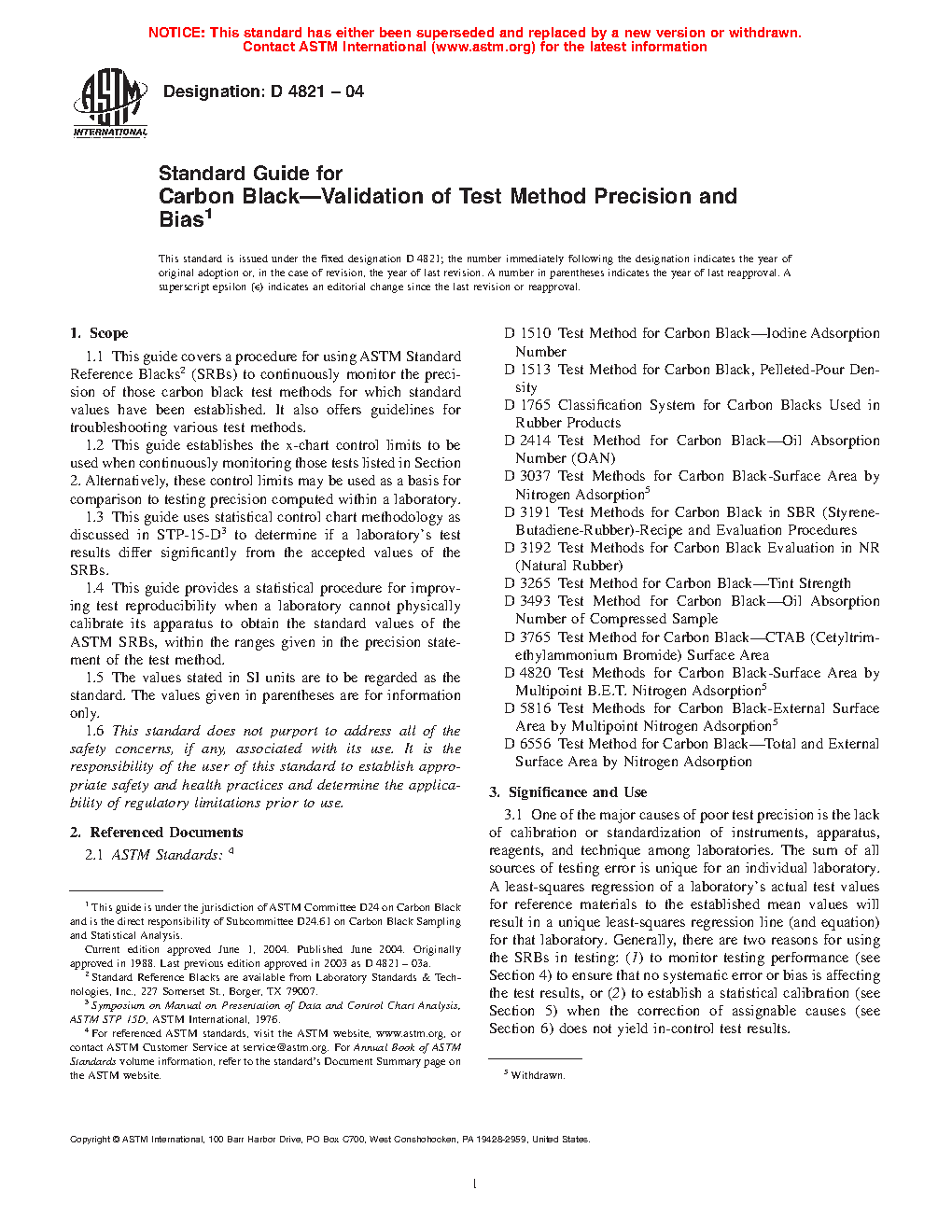
1.1 This guide covers procedures for using the ASTM Standard Reference Blacks (SRBs) reference materials, the HT and INR (Iodine Number Reference) Iodine Number reference materials and, the High Nitrogen Surface Area (HNSA) reference materials, to continuously monitor the precision of those carbon black test methods for which reference values have been established. It also offers guidelines for troubleshooting various test methods.
1.2 This guide defines the environmental conditions that are required for laboratories that perform carbon black testing activities for those test methods under D24’s jurisdiction.
1.3 This guide establishes procedures for the use of x-charts to continuously monitor those tests listed in Section 2 for within-lab precision (repeatability) and between-lab accuracy (reproducibility).
1.4 This guide provides a statistical procedure for improving test reproducibility when a laboratory cannot physically calibrate its apparatus to obtain the reference values of the ASTM reference blacks, within the ranges given in this guide.
1.5 This international standard was developed in accordance with internationally recognized principles on standardization established in the Decision on Principles for the Development of International Standards, Guides and Recommendations issued by the World Trade Organization Technical Barriers to Trade (TBT) Committee.
Significance and Use:
4.1 This guide provides insight into the environmental conditions required for the operation of laboratories or to aid in the design of new laboratories that perform carbon black testing activities using those test methods that are under D24’s jurisdiction. This guide does not supersede any specific requirements a laboratory may choose to establish.
4.2 This guide recommends the use of statistical x-charts to graphically monitor test data determined for the ASTM reference materials for those test methods given in 2.1. All laboratories are encouraged to utilize statistical x-charts and ASTM reference materials because this enables a comparison of testing precision within and between laboratories. The guide describes practices for the use of repeatability and reproducibility limits and x-charts.
4.3 In addition to the calibration of a test method by physicochemical means, a statistical method for achieving calibration of a test method is presented (that is, normalization).
4.4 Poor test precision can be the result of poor repeatability or poor reproducibility or both. Causes may include inadequate operator training, improperly maintained equipment or laboratory environment, variation in sample preparation or analysis techniques, the lack of calibration or standardization of instrumentation, worn-out apparatus, reagents that do not meet specifications, different sources of instrumentation or equipment, and material heterogeneity. The sum of all sources of testing error is unique for an individual laboratory.
4.5 Precision data for ASTM Reference Materials are found in the documents listed in 2.2. These include standard reference materials (SRBs) Series 8 and 9, HT and INR Iodine Standards, and High Nitrogen Surface Area reference material. The HT or INR Iodine standards are recommended for monitoring iodine testing. The HNSA reference material is used to extend the calibration range for monitoring the NSA, STSA, and Tint testing of high surface area carbon blacks.
Technical characteristics
| Publisher | American Society for Testing and Materials (ASTM International) |
| Publication Date | 12/15/2025 |
| Collection | |
| Page Count | 10 |
| Themes | Rubber compounding ingredients |
| EAN | --- |
| ISBN | --- |
| Weight (in grams) | --- |
Replaces

Previous versions