ASTM D4889-04(2011)
 Preview
Summary
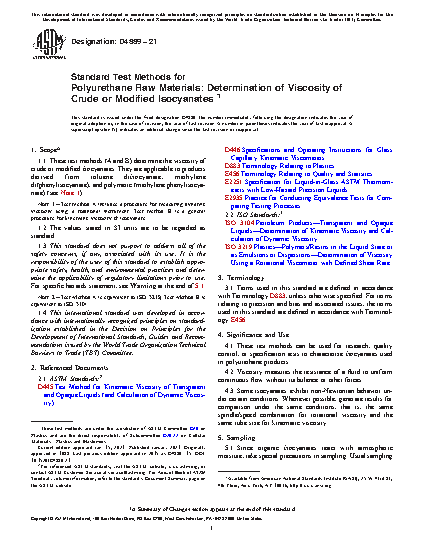
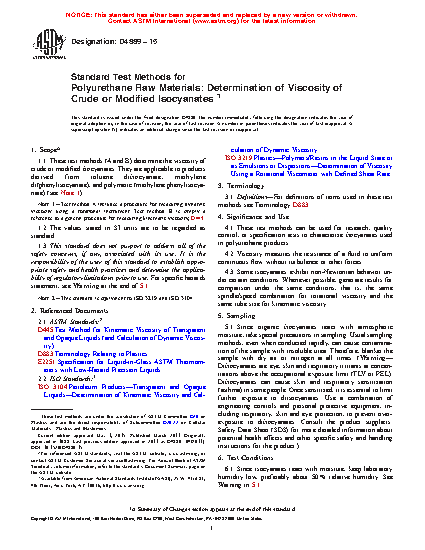
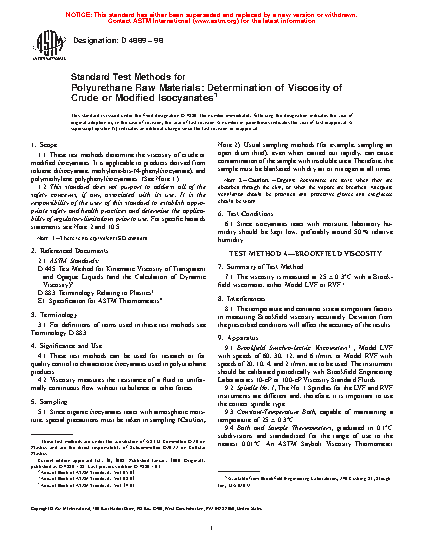
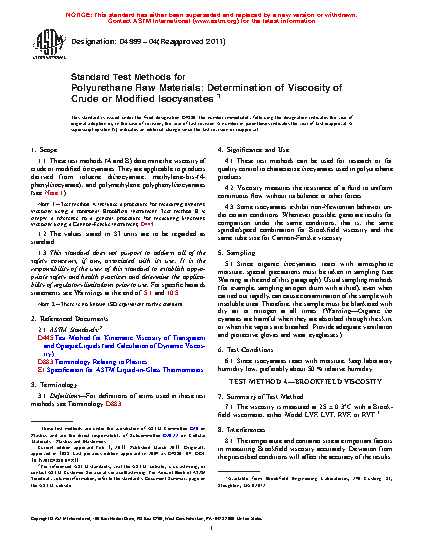
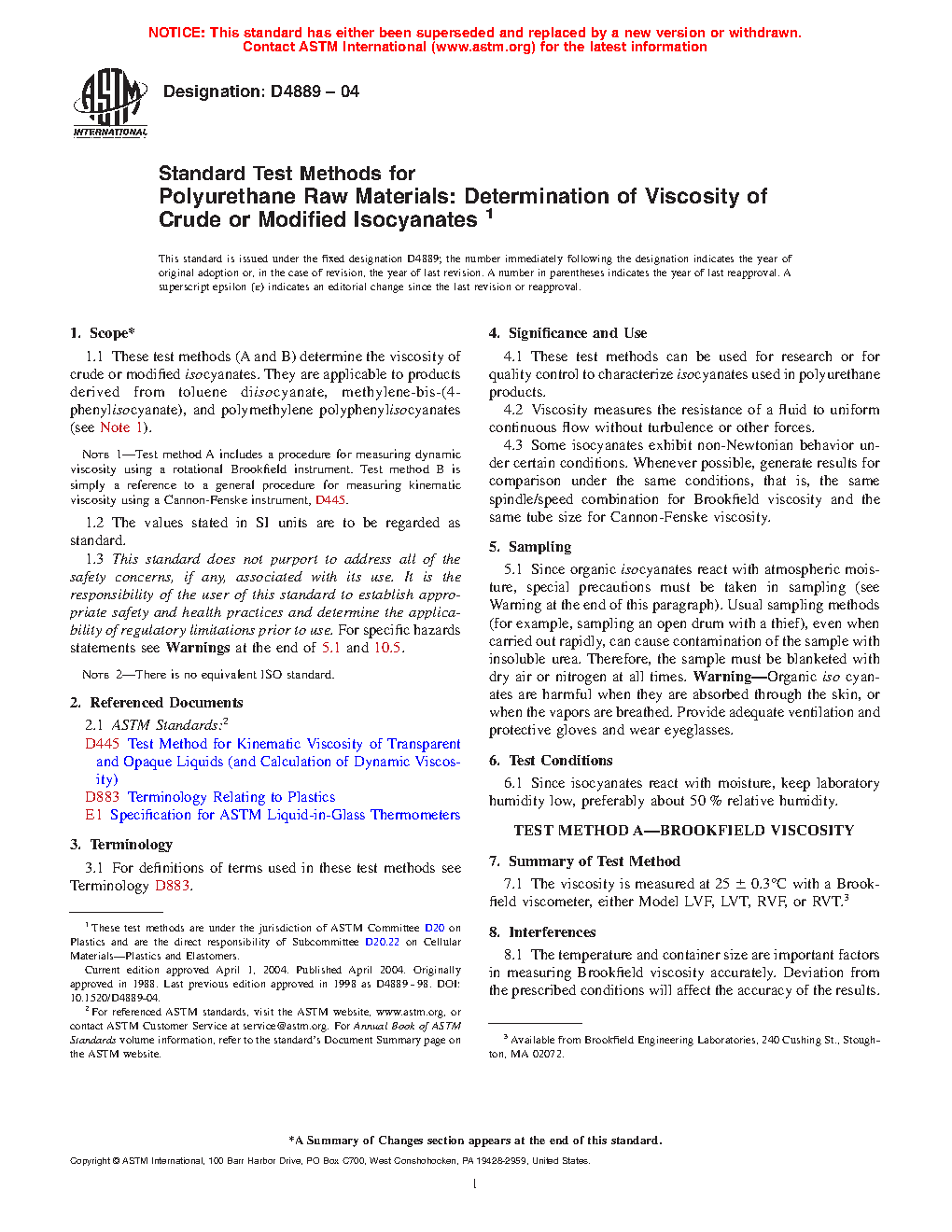
1.1 These test methods (A and B) determine the viscosity of crude or modified isocyanates. They are applicable to products derived from toluene diisocyanate, methylene-bis-(4-phenylisocyanate), and polymethylene polyphenylisocyanates (see Note 1).
Note 1—Test method A includes a procedure for measuring dynamic viscosity using a rotational Brookfield instrument. Test method B is simply a reference to a general procedure for measuring kinematic viscosity using a Cannon-Fenske instrument, D445.
1.2 The values stated in SI units are to be regarded as standard.
1.3 This standard does not purport to address all of the safety concerns, if any, associated with its use. It is the responsibility of the user of this standard to establish appropriate safety and health practices and determine the applicability of regulatory limitations prior to use. For specific hazards statements see Warnings at the end of 5.1 and 10.5.
Note 2—There is no known ISO equivalent to this standard.
Significance and Use:
These test methods can be used for research or for quality control to characterize isocyanates used in polyurethane products.
Viscosity measures the resistance of a fluid to uniform continuous flow without turbulence or other forces.
Some isocyanates exhibit non-Newtonian behavior under certain conditions. Whenever possible, generate results for comparison under the same conditions, that is, the same spindle/speed combination for Brookfield viscosity and the same tube size for Cannon-Fenske viscosity.
Technical characteristics
| Publisher | American Society for Testing and Materials (ASTM International) |
| Publication Date | 04/01/2004 |
| Confirmation Date | 02/01/2011 |
| Collection | |
| Page Count | 3 |
| Themes | Thermoplastic materials |
| EAN | --- |
| ISBN | --- |
| Weight (in grams) | --- |
Replaces
Previous versions