
ASTM D545-99(2005)
 Preview
Summary
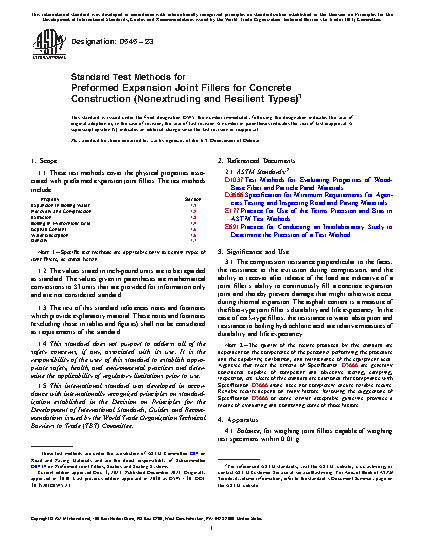
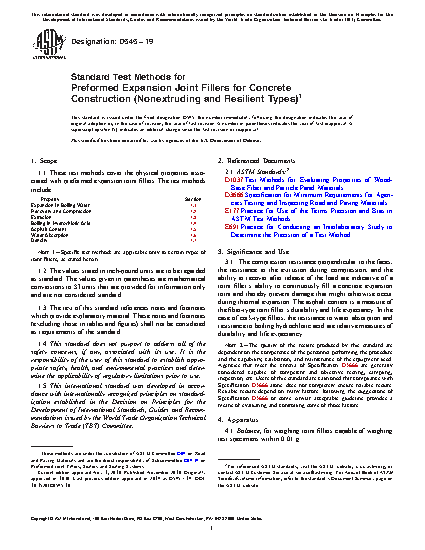
1.1 These test methods cover the physical properties associated with preformed expansion joint fillers. The test methods include:
| Property | Section |
| Asphalt content | 7.5 |
| Boiling in hydrochloric acid | 7.4 |
| Compression | 7.2 |
| Density | 7.7 |
| Expansion in boiling water | 7.1 |
| Extrusion | 7.3 |
| Recovery | 7.2 |
| Water absorption | 7.6 |
1.2 The values stated in inch-pound are to be regarded as standard.
Note 1—Specific test methods are applicable only to certain types of joint fillers, as stated herein.
1.3 This standard does not purport to address all of the safety concerns, if any, associated with its use. It is the responsibility of the user of this standard to consult and establish appropriate safety and health practices and determine the applicability of regulatory limitations prior to use.
Significance and Use:
The compression resistance perpendicular to the faces, the resistance to the extrusion during compression, and the ability to recover after release of the load are indicative of a joint filler’ability to fill continuously a concrete expansion joint and thereby prevent damage that might otherwise occur during thermal expansion. The asphalt content is a measure of the fiber-type joint filler’durability and life expectancy. In the case of cork-type fillers, the resistance to water absorption and resistance to boiling hydrochloric acid are relative measures of durability and life expectancy.
Technical characteristics
| Publisher | American Society for Testing and Materials (ASTM International) |
| Publication Date | 06/10/1999 |
| Confirmation Date | 07/15/2005 |
| Collection | |
| Page Count | 4 |
| Themes | Sealing materials |
| EAN | --- |
| ISBN | --- |
| Weight (in grams) | --- |
Replaces
Previous versions