
ASTM D5573-99(2012)
 Preview
Summary
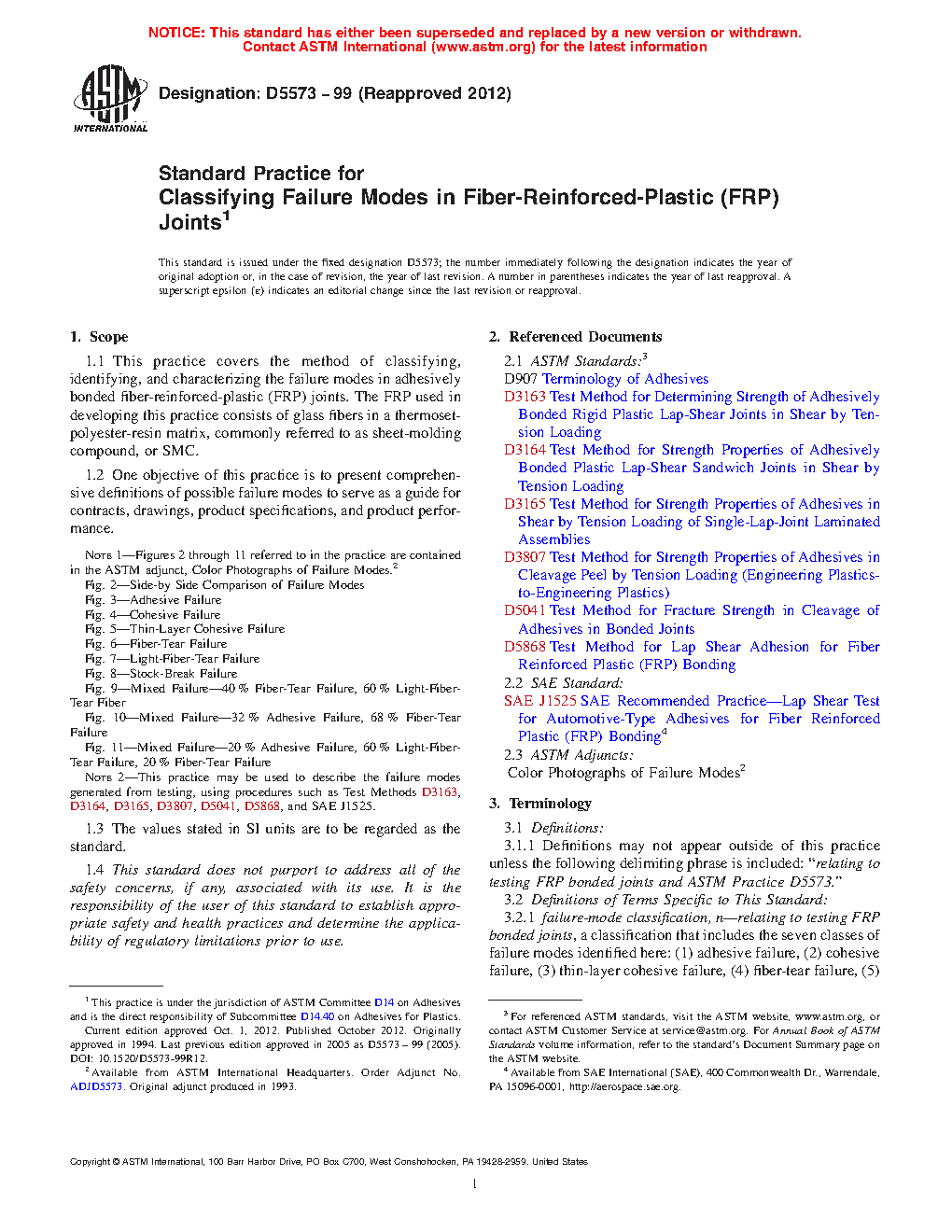
1.1 This practice covers the method of classifying, identifying, and characterizing the failure modes in adhesively bonded fiber-reinforced-plastic (FRP) joints. The FRP used in developing this practice consists of glass fibers in a thermoset-polyester-resin matrix, commonly referred to as sheet-molding compound, or SMC.
1.2 One objective of this practice is to present comprehensive definitions of possible failure modes to serve as a guide for contracts, drawings, product specifications, and product performance.
Fig. 2—Side-by Side Comparison of Failure Modes
Fig. 3—Adhesive Failure
Fig. 4—Cohesive Failure
Fig. 5—Thin-Layer Cohesive Failure
Fig. 6—Fiber-Tear Failure
Fig. 7—Light-Fiber-Tear Failure
Fig. 8—Stock-Break Failure
Fig. 9—Mixed Failure—40 % Fiber-Tear Failure, 60 % Light-Fiber-Tear Fiber
Fig. 10—Mixed Failure—32 % Adhesive Failure, 68 % Fiber-Tear Failure
Fig. 11—Mixed Failure—20 % Adhesive Failure, 60 % Light-Fiber-Tear Failure, 20 % Fiber-Tear Failure
1.3 The values stated in SI units are to be regarded as the standard.
1.4 This standard does not purport to address all of the safety concerns, if any, associated with its use. It is the responsibility of the user of this standard to establish appropriate safety and health practices and determine the applicability of regulatory limitations prior to use.
Significance and Use:
4.1 This practice provides a simple means of classifying failure modes for adhesively bonded FRP joints.
4.2 Each failure mode classification is based solely on a visual observation of the failure surface without the aid of a microscope or other means to magnify the surface.
Technical characteristics
| Publisher | American Society for Testing and Materials (ASTM International) |
| Publication Date | 04/10/1999 |
| Confirmation Date | 10/01/2012 |
| Collection | |
| Page Count | 3 |
| Themes | Reinforced plastics |
| EAN | --- |
| ISBN | --- |
| Weight (in grams) | --- |
Replaces

Previous versions

