ASTM D6031/D6031M-25
 Preview
Summary
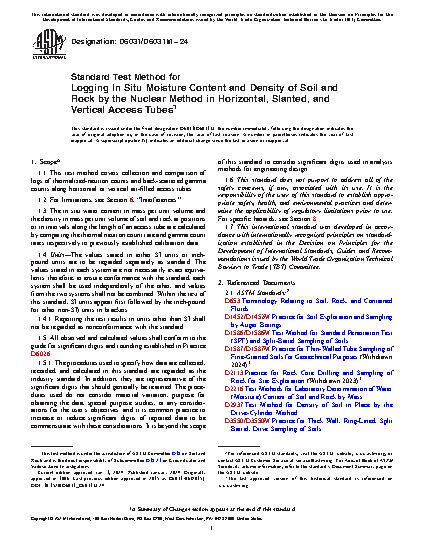
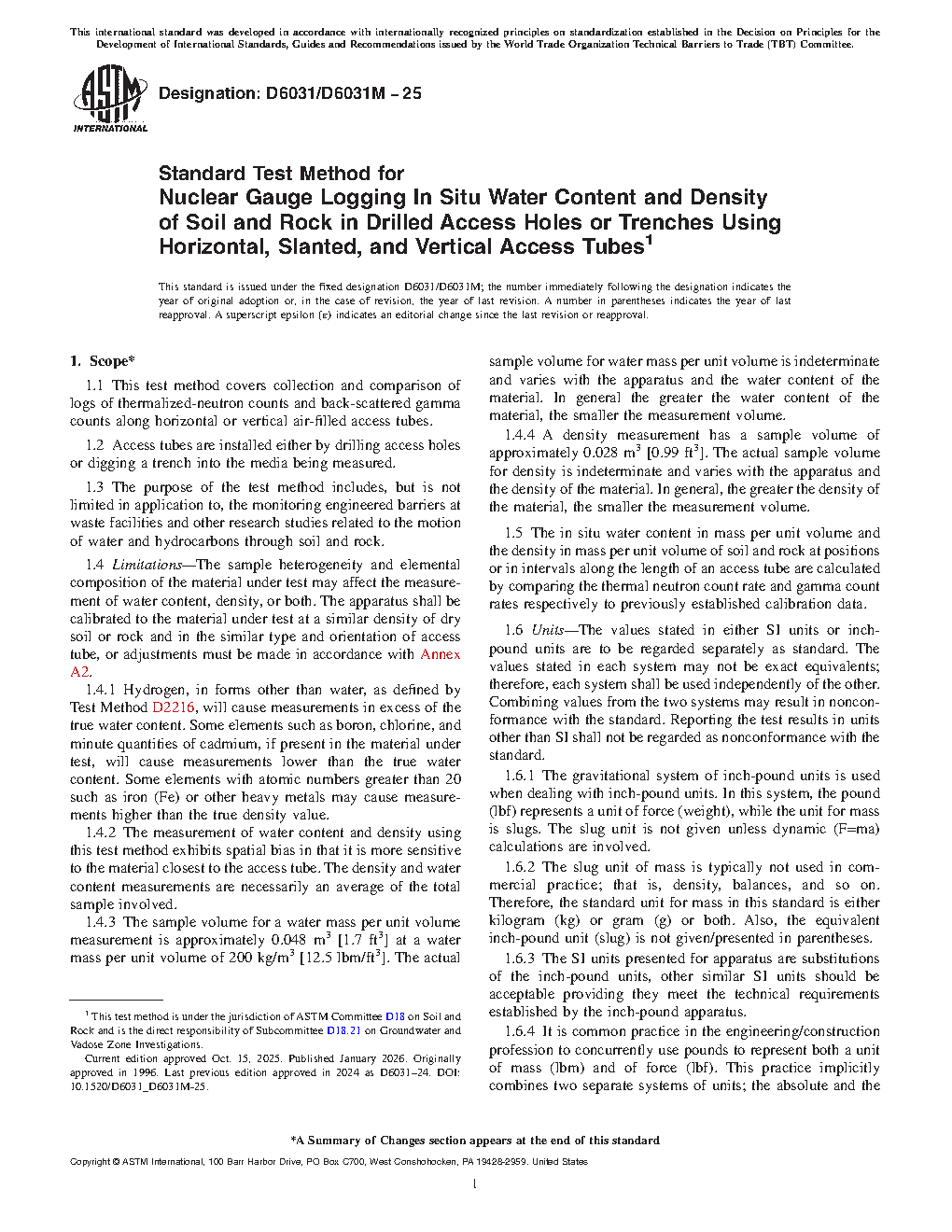
1.1 This test method covers collection and comparison of logs of thermalized-neutron counts and back-scattered gamma counts along horizontal or vertical air-filled access tubes.
1.2 Access tubes are installed either by drilling access holes or digging a trench into the media being measured.
1.3 The purpose of the test method includes, but is not limited in application to, the monitoring engineered barriers at waste facilities and other research studies related to the motion of water and hydrocarbons through soil and rock.
1.4 Limitations—The sample heterogeneity and elemental composition of the material under test may affect the measurement of water content, density, or both. The apparatus shall be calibrated to the material under test at a similar density of dry soil or rock and in the similar type and orientation of access tube, or adjustments must be made in accordance with Annex A2.
1.4.1 Hydrogen, in forms other than water, as defined by Test Method D2216, will cause measurements in excess of the true water content. Some elements such as boron, chlorine, and minute quantities of cadmium, if present in the material under test, will cause measurements lower than the true water content. Some elements with atomic numbers greater than 20 such as iron (Fe) or other heavy metals may cause measurements higher than the true density value.
1.4.2 The measurement of water content and density using this test method exhibits spatial bias in that it is more sensitive to the material closest to the access tube. The density and water content measurements are necessarily an average of the total sample involved.
1.4.3 The sample volume for a water mass per unit volume measurement is approximately 0.048 m3 [1.7 ft3] at a water mass per unit volume of 200 kg/m3 [12.5 lbm/ft3]. The actual sample volume for water mass per unit volume is indeterminate and varies with the apparatus and the water content of the material. In general the greater the water content of the material, the smaller the measurement volume.
1.4.4 A density measurement has a sample volume of approximately 0.028 m3 [0.99 ft3]. The actual sample volume for density is indeterminate and varies with the apparatus and the density of the material. In general, the greater the density of the material, the smaller the measurement volume.
1.5 The in situ water content in mass per unit volume and the density in mass per unit volume of soil and rock at positions or in intervals along the length of an access tube are calculated by comparing the thermal neutron count rate and gamma count rates respectively to previously established calibration data.
1.6 Units—The values stated in either SI units or inch-pound units are to be regarded separately as standard. The values stated in each system may not be exact equivalents; therefore, each system shall be used independently of the other. Combining values from the two systems may result in nonconformance with the standard. Reporting the test results in units other than SI shall not be regarded as nonconformance with the standard.
1.6.1 The gravitational system of inch-pound units is used when dealing with inch-pound units. In this system, the pound (lbf) represents a unit of force (weight), while the unit for mass is slugs. The slug unit is not given unless dynamic (F=ma) calculations are involved.
1.6.2 The slug unit of mass is typically not used in commercial practice; that is, density, balances, and so on. Therefore, the standard unit for mass in this standard is either kilogram (kg) or gram (g) or both. Also, the equivalent inch-pound unit (slug) is not given/presented in parentheses.
1.6.3 The SI units presented for apparatus are substitutions of the inch-pound units, other similar SI units should be acceptable providing they meet the technical requirements established by the inch-pound apparatus.
1.6.4 It is common practice in the engineering/construction profession to concurrently use pounds to represent both a unit of mass (lbm) and of force (lbf). This practice implicitly combines two separate systems of units; the absolute and the gravitational systems. It is scientifically undesirable to combine the use of two separate sets of inch-pound units within a single standard. As stated, this standard includes the gravitational system of inch-pound units and does not use/present the slug unit for mass. However, the use of balances or scales recording pounds of mass (lbm) or recording density in lbm/ft3 shall not be regarded as nonconformance with this standard.
1.6.5 The terms density and unit weight are often used interchangeably. Density is mass per unit volume, whereas unit weight is force per unit volume. In this standard, density is given only in SI units. After density has been determined, the unit weight is calculated in SI or inch-pound units or both.
1.7 All observed and calculated values shall conform to the guide for significant digits and rounding established in Practice D6026.
1.7.1 The procedures used to specify how data are collected, recorded, and calculated in this standard are regarded as the industry standard. In addition, they are representative of the significant digits that should generally be retained. The procedures used do not consider material variation, purpose for obtaining the data, special purpose studies, or any considerations for the user’s objectives; and it is common practice to increase or reduce significant digits of reported data to be commensurate with these considerations. It is beyond the scope of this standard to consider significant digits used in analysis methods for engineering design.
1.8 This standard does not purport to address all of the safety concerns, if any, associated with its use. It is the responsibility of the user of this standard to establish appropriate safety, health, and environmental practices and determine the applicability of regulatory limitations prior to use. For specific hazards, see Section 8.
1.9 This international standard was developed in accordance with internationally recognized principles on standardization established in the Decision on Principles for the Development of International Standards, Guides and Recommendations issued by the World Trade Organization Technical Barriers to Trade (TBT) Committee.
Significance and Use:
5.1 This test method is useful as a repeatable, nondestructive technique to monitor in-place density and water content of soil and rock along lengthy sections of horizontal, slanted, and vertical access holes or tubes. With proper calibration in accordance with Annex A1, this test method can be used to quantify changes in density and water content of soil and rock.
5.2 This test method is used in vadose zone monitoring, for performance assessment of engineered barriers at waste facilities, and for research related to monitoring the movement of water solutions and hydrocarbons through soil and rock. The nondestructive nature of the test allows repetitive measurements at a site and statistical analysis of results.
5.3 The fundamental assumptions inherent in the density measurement portion of this test method are that Compton scattering and photoelectric absorption are the dominant interactions of the gamma rays with the material under test.
5.4 The probe response, in counts, is converted to wet density by comparing the detected rate of gamma radiation with previously established calibration data (see Annex A1).
5.5 The probe count response may also be utilized directly for unitless, relative comparison with other probe readings.
5.5.1 For materials of densities higher than that of about the density of water, higher count rates within the same soil type relate to lower densities and, conversely, lower count rates within the same soil type relate to higher densities.
5.5.2 For materials of densities lower than the density of water, higher count rates within the same soil type relate to higher densities and, conversely, lower count rates within the same soil type relate to lower densities.
5.5.3 Because of the functional inflection of probe response for densities near the density of water, exercise great care when drawing conclusions from probe response in this density range.
5.6 The fundamental assumption inherent in the water content measurement portion of this test is that the hydrogen contained in the water molecules within the soil and rock is the dominant neutron thermalizing media, so increased water content of the soil and rock results in higher count rates of the water content system of the instrument.
Note 1: The quality of the result produced by this standard is dependent on the competence of the personnel performing it and the suitability of the equipment and facility used. Agencies that meet the criteria of Practice D3740 are generally considered capable of competent and objective testing/sampling/inspection. Reliable results depend on many factors; Practice D3740 provides a means of evaluating some, but not all, of those factors.
Technical characteristics
| Publisher | American Society for Testing and Materials (ASTM International) |
| Publication Date | 10/15/2025 |
| Collection | |
| Page Count | 10 |
| Themes | Physicochemical methods of analysis |
| EAN | --- |
| ISBN | --- |
| Weight (in grams) | --- |
Replaces
Previous versions