
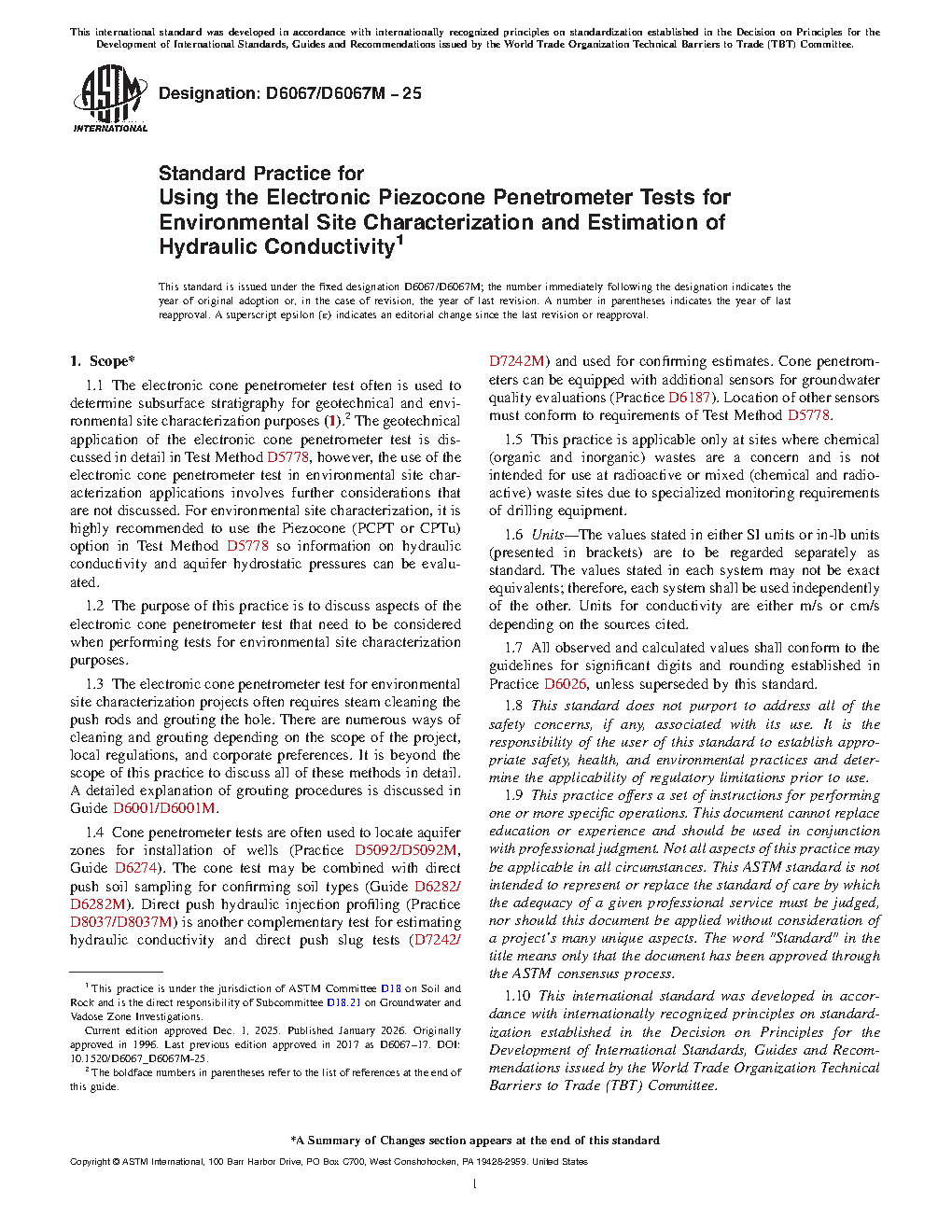
ASTM D6067/D6067M-25
 Preview
Summary
1.1 The electronic cone penetrometer test often is used to determine subsurface stratigraphy for geotechnical and environmental site characterization purposes (1).2 The geotechnical application of the electronic cone penetrometer test is discussed in detail in Test Method D5778, however, the use of the electronic cone penetrometer test in environmental site characterization applications involves further considerations that are not discussed. For environmental site characterization, it is highly recommended to use the Piezocone (PCPT or CPTu) option in Test Method D5778 so information on hydraulic conductivity and aquifer hydrostatic pressures can be evaluated.
1.2 The purpose of this practice is to discuss aspects of the electronic cone penetrometer test that need to be considered when performing tests for environmental site characterization purposes.
1.3 The electronic cone penetrometer test for environmental site characterization projects often requires steam cleaning the push rods and grouting the hole. There are numerous ways of cleaning and grouting depending on the scope of the project, local regulations, and corporate preferences. It is beyond the scope of this practice to discuss all of these methods in detail. A detailed explanation of grouting procedures is discussed in Guide D6001/D6001M.
1.4 Cone penetrometer tests are often used to locate aquifer zones for installation of wells (Practice D5092/D5092M, Guide D6274). The cone test may be combined with direct push soil sampling for confirming soil types (Guide D6282/D6282M). Direct push hydraulic injection profiling (Practice D8037/D8037M) is another complementary test for estimating hydraulic conductivity and direct push slug tests (D7242/D7242M) and used for confirming estimates. Cone penetrometers can be equipped with additional sensors for groundwater quality evaluations (Practice D6187). Location of other sensors must conform to requirements of Test Method D5778.
1.5 This practice is applicable only at sites where chemical (organic and inorganic) wastes are a concern and is not intended for use at radioactive or mixed (chemical and radioactive) waste sites due to specialized monitoring requirements of drilling equipment.
1.6 Units—The values stated in either SI units or in-lb units (presented in brackets) are to be regarded separately as standard. The values stated in each system may not be exact equivalents; therefore, each system shall be used independently of the other. Units for conductivity are either m/s or cm/s depending on the sources cited.
1.7 All observed and calculated values shall conform to the guidelines for significant digits and rounding established in Practice D6026, unless superseded by this standard.
1.8 This standard does not purport to address all of the safety concerns, if any, associated with its use. It is the responsibility of the user of this standard to establish appropriate safety, health, and environmental practices and determine the applicability of regulatory limitations prior to use.
1.9 This practice offers a set of instructions for performing one or more specific operations. This document cannot replace education or experience and should be used in conjunction with professional judgment. Not all aspects of this practice may be applicable in all circumstances. This ASTM standard is not intended to represent or replace the standard of care by which the adequacy of a given professional service must be judged, nor should this document be applied without consideration of a project's many unique aspects. The word "Standard" in the title means only that the document has been approved through the ASTM consensus process.
1.10 This international standard was developed in accordance with internationally recognized principles on standardization established in the Decision on Principles for the Development of International Standards, Guides and Recommendations issued by the World Trade Organization Technical Barriers to Trade (TBT) Committee.
Significance and Use:
4.1 Environmental site characterization projects almost always require information regarding subsurface soil stratigraphy and hydraulic parameters related to groundwater flow rate and direction. Soil stratigraphy often is determined by various drilling procedures and interpreting the data collected on borehole logs. The electronic piezocone penetrometer test is another means of determining soil stratigraphy that may be faster, less expensive, and provide greater resolution of the soil units than conventional drilling and sampling methods. For environmental site characterization applications, the electronic piezocone also has the additional advantage of not generating contaminated cuttings that may present other disposal problems (2, 3, 4, 5, 6, 7, 8, 9, 10). Investigators may obtain soil samples from adjacent borings for correlation purposes, but prior information or experience in the same area may preclude the need for borings (11). Most cone penetrometer rigs are equipped with direct push soil samplers (Guide D6282/D6282M) that can be used to confirm soil types.
4.2 The electronic piezocone penetration test is an in situ investigation method involving:
4.2.1 Pushing an electronically instrumented probe into the ground (see Fig. 1 for a diagram of a typical cone penetrometer). The position of the pore pressure element may vary but is typically located in the u2 position, as shown in Fig. 1 (Test Method D5778).
Technical characteristics
| Publisher | American Society for Testing and Materials (ASTM International) |
| Publication Date | 12/01/2025 |
| Collection | |
| Page Count | 14 |
| Themes | Physical properties of soil |
| EAN | --- |
| ISBN | --- |
| Weight (in grams) | --- |
Replaces
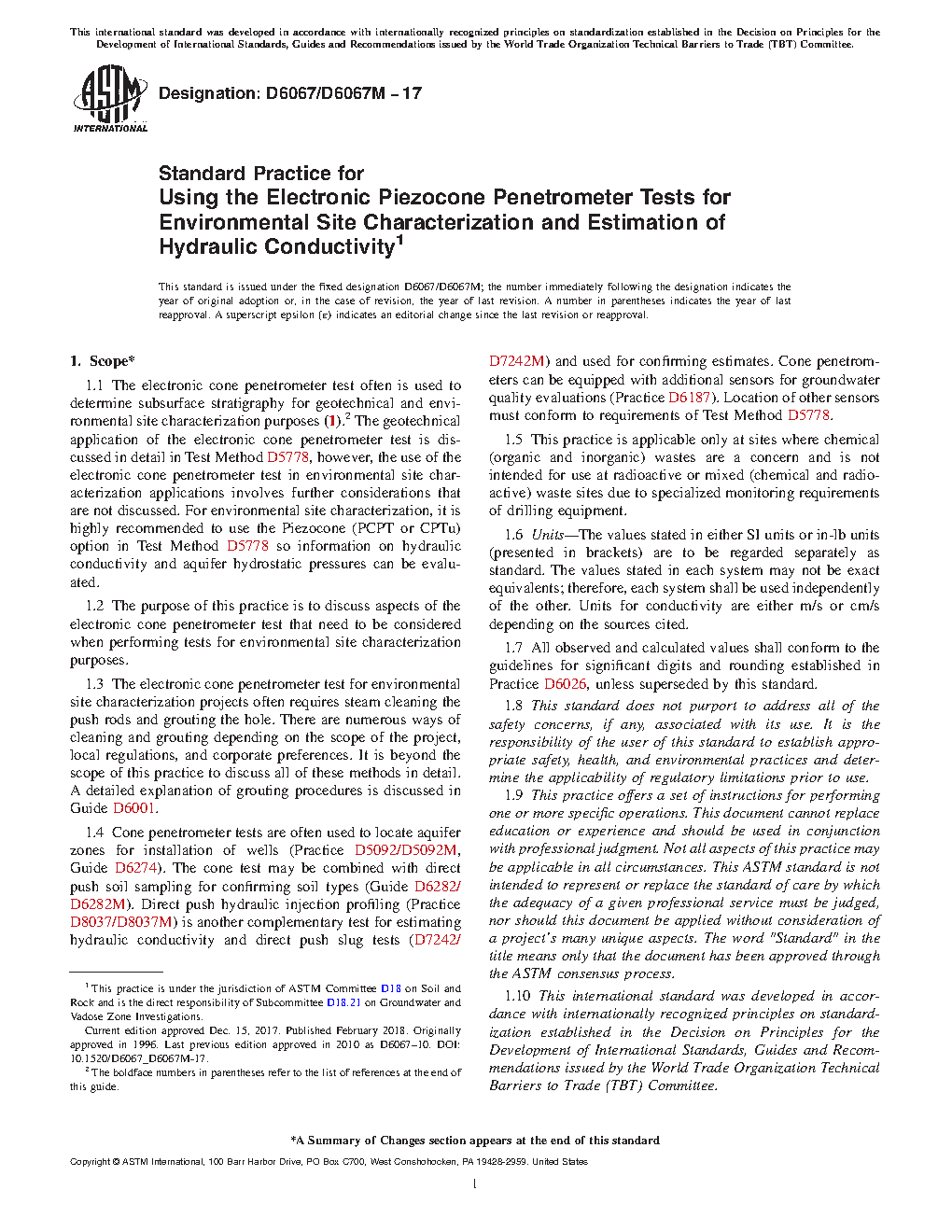
Previous versions