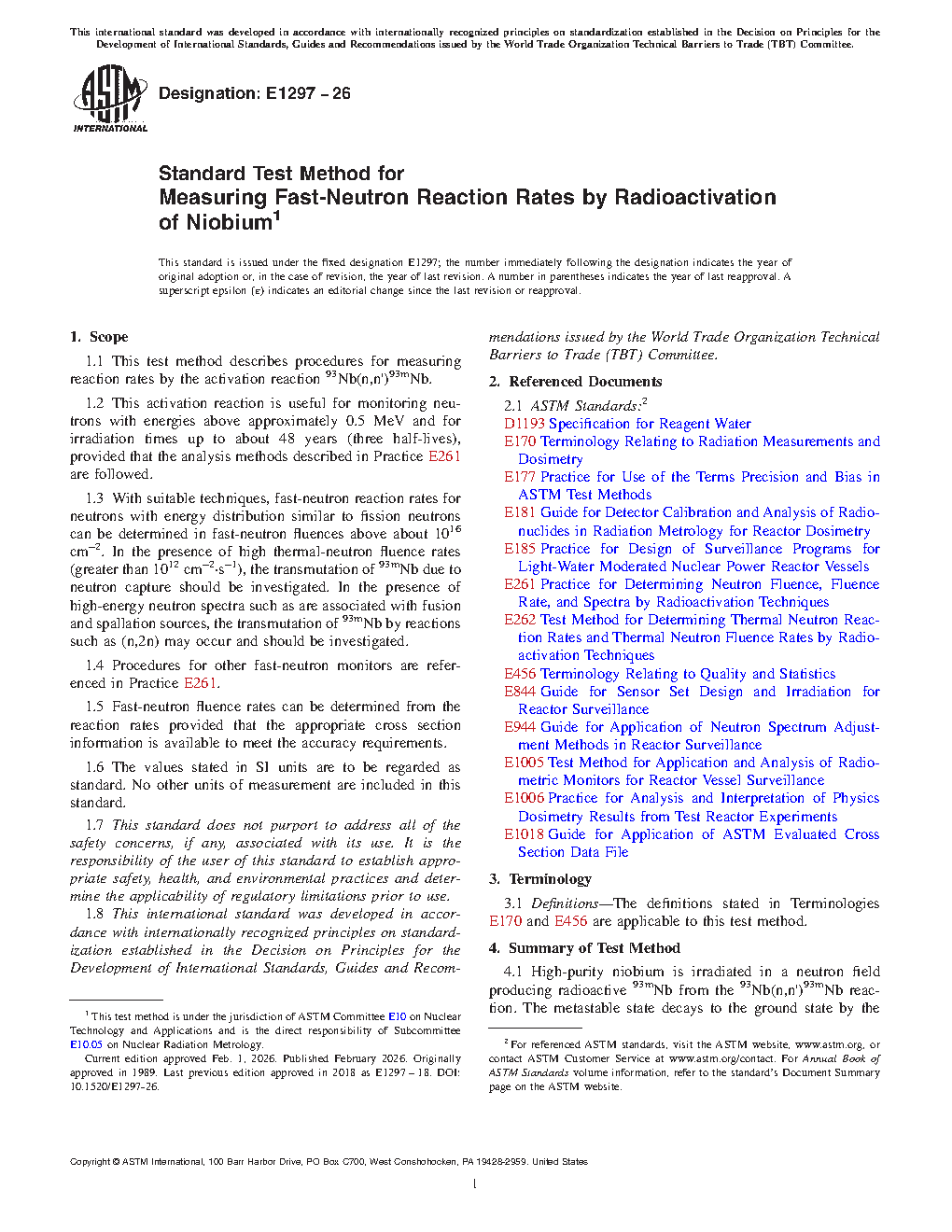
ASTM E1297-26
 Preview
Summary
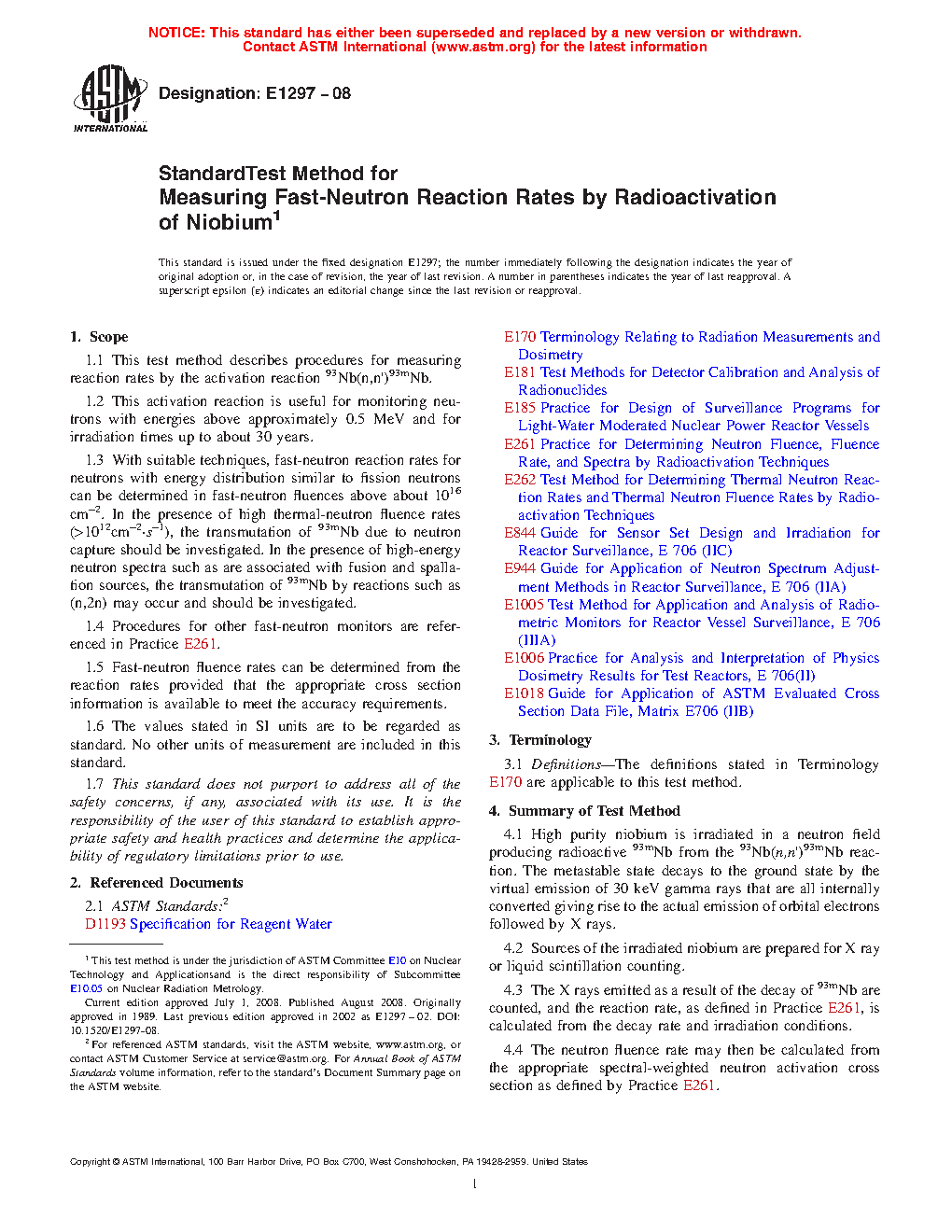
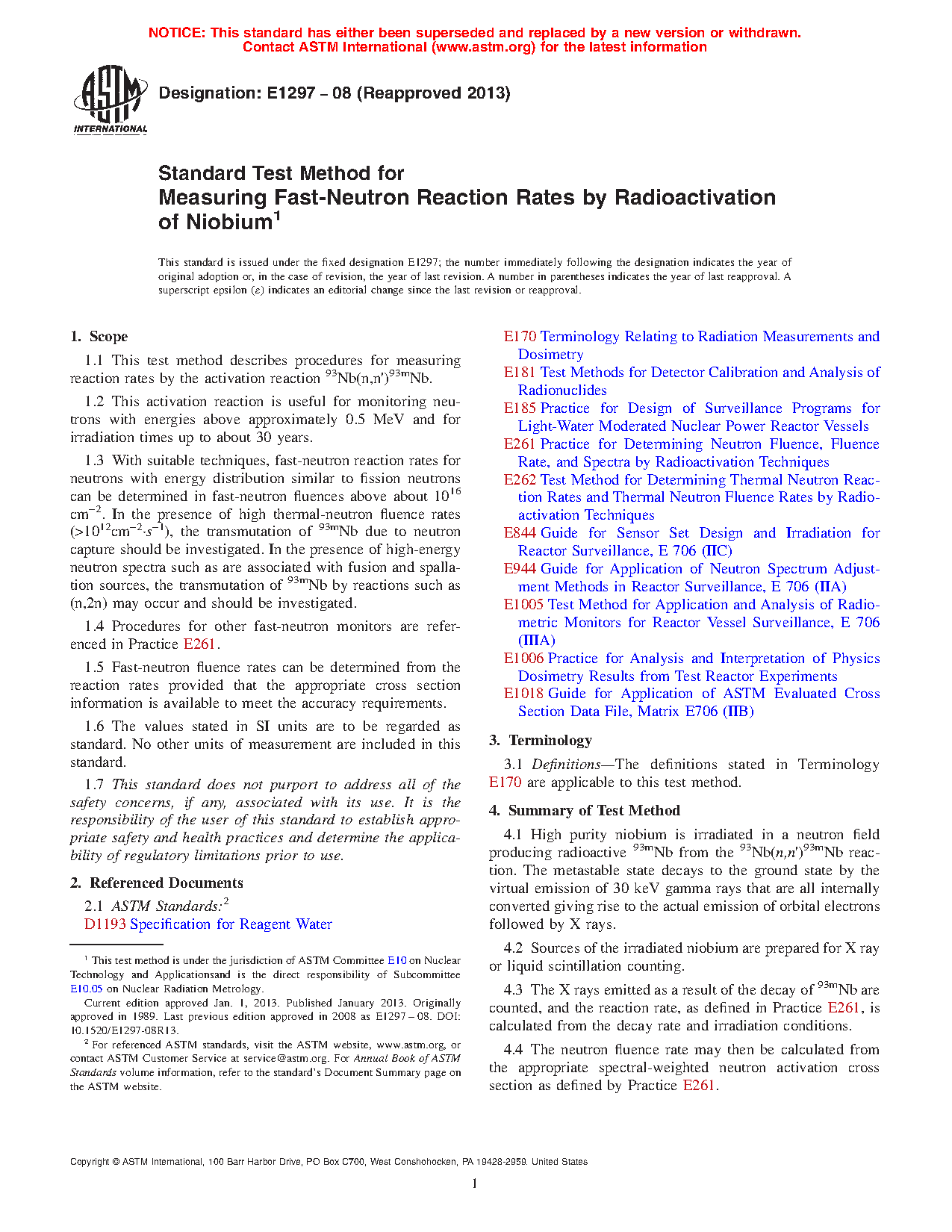
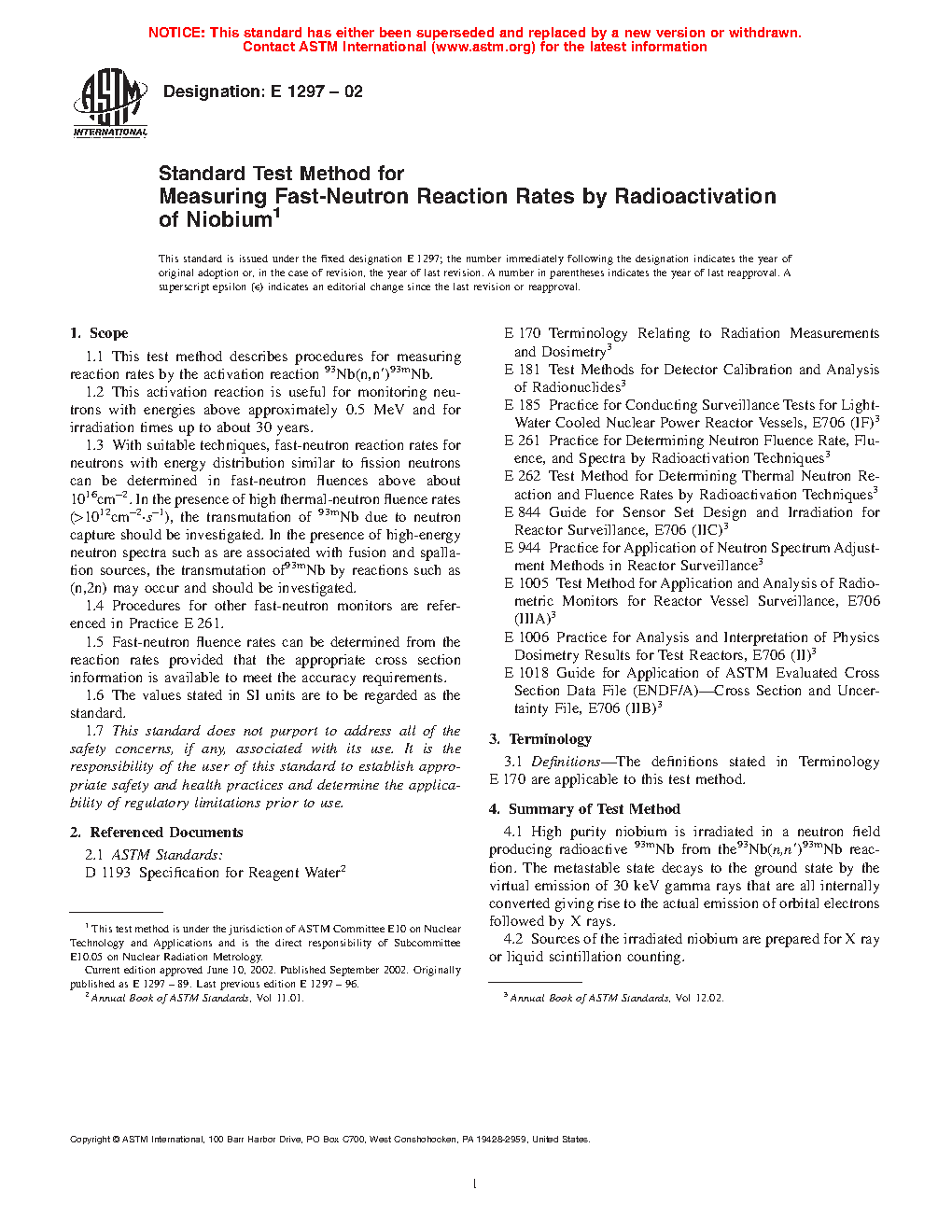
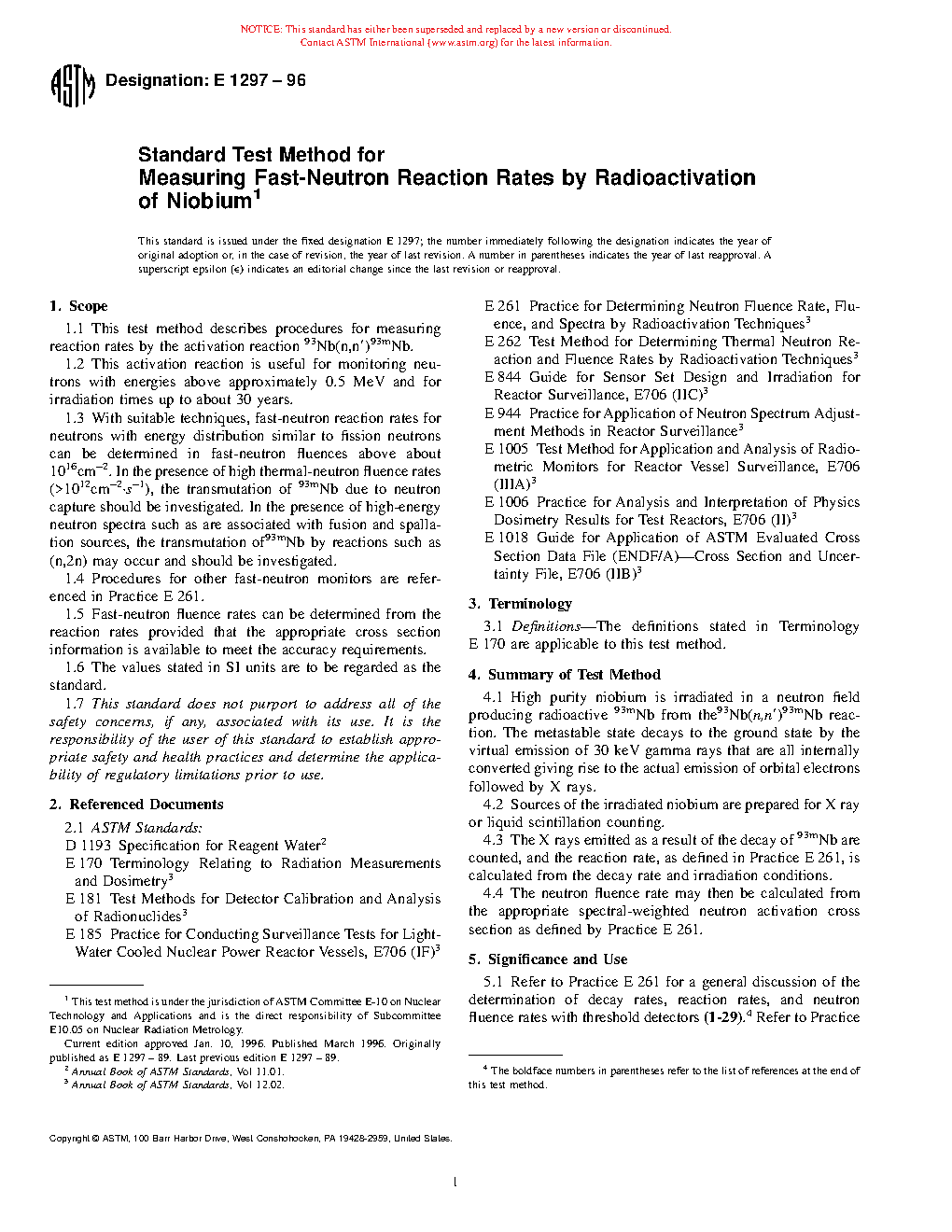
1.1 This test method describes procedures for measuring reaction rates by the activation reaction 93Nb(n,n')93mNb.
1.2 This activation reaction is useful for monitoring neutrons with energies above approximately 0.5 MeV and for irradiation times up to about 48 years (three half-lives), provided that the analysis methods described in Practice E261 are followed.
1.3 With suitable techniques, fast-neutron reaction rates for neutrons with energy distribution similar to fission neutrons can be determined in fast-neutron fluences above about 1016 cm-2. In the presence of high thermal-neutron fluence rates (greater than 1012 cm-2·s-1), the transmutation of 93mNb due to neutron capture should be investigated. In the presence of high-energy neutron spectra such as are associated with fusion and spallation sources, the transmutation of 93mNb by reactions such as (n,2n) may occur and should be investigated.
1.4 Procedures for other fast-neutron monitors are referenced in Practice E261.
1.5 Fast-neutron fluence rates can be determined from the reaction rates provided that the appropriate cross section information is available to meet the accuracy requirements.
1.6 The values stated in SI units are to be regarded as standard. No other units of measurement are included in this standard.
1.7 This standard does not purport to address all of the safety concerns, if any, associated with its use. It is the responsibility of the user of this standard to establish appropriate safety, health, and environmental practices and determine the applicability of regulatory limitations prior to use.
1.8 This international standard was developed in accordance with internationally recognized principles on standardization established in the Decision on Principles for the Development of International Standards, Guides and Recommendations issued by the World Trade Organization Technical Barriers to Trade (TBT) Committee.
Significance and Use:
5.1 Refer to Practice E261 for a general discussion of the determination of decay rates, reaction rates, and neutron fluence rates with threshold detectors (1-29). Refer to Practice E1006, Practice E185, and Guide E1018 for the use and application of results obtained by this test method (30-32).
5.2 The half-life of 93mNb is 16.1 (2) years (35) and has a K X-ray emission probability of 0.11546 ± 1.516 % per decay (33). The Ka and Kß X-rays of niobium are at 16.5213 to 16.6152 and 18.67 to 18.967 keV, respectively (36). The recommended 93Nb(n,n')93mNb cross section comes from the International Reactor Dosimetry and Fusion File (IRDFF-II) cross section compendium (33) and is shown in Fig. 1. The nuclear decay data referenced here are not taken from the latest dosimetry recommended database (34) but are selected to be consistent with the nuclear data used in the recommended IRDFF evaluation.
5.3 Since 93mNb emits low-energy photons compared to many activated materials used for metrology, some considerations must be taken into account during measurement:
5.3.1 Chemical dissolution of the irradiated niobium to produce very low mass-per-unit area sources is an effective way to obtain consistent results. The direct counting of foils or wires can produce satisfactory results provided appropriate methods and interpretations are employed. It is possible to use liquid scintillation methods to measure the niobium activity provided the radioactive material can be kept uniformly in solution and appropriate corrections can be made for interfering activities.
5.4 The measured reaction rates can be used to correlate neutron exposures, provide comparison with calculated reaction rates, and determine neutron fluences. Reaction rates can be determined with greater accuracy than fluence rates because of the current uncertainty in the cross section versus energy shape.
5.5 The 93Nb(n,n')93mNb reaction has the desirable properties of monitoring neutron exposures related to neutron damage of nuclear facility structural components. It has an energy response range corresponding to the damage function of steel and has a half-life sufficiently long to allow its use in very long exposures (up to about 48 years). Monitoring long exposures is useful in determining the long-term integrity of nuclear facility components.
Technical characteristics
| Publisher | American Society for Testing and Materials (ASTM International) |
| Publication Date | 02/01/2026 |
| Collection | |
| Page Count | 8 |
| Themes | Nuclear energy in general |
| EAN | --- |
| ISBN | --- |
| Weight (in grams) | --- |
Replaces
Previous versions