
ASTM E3439-25
 Preview
Summary
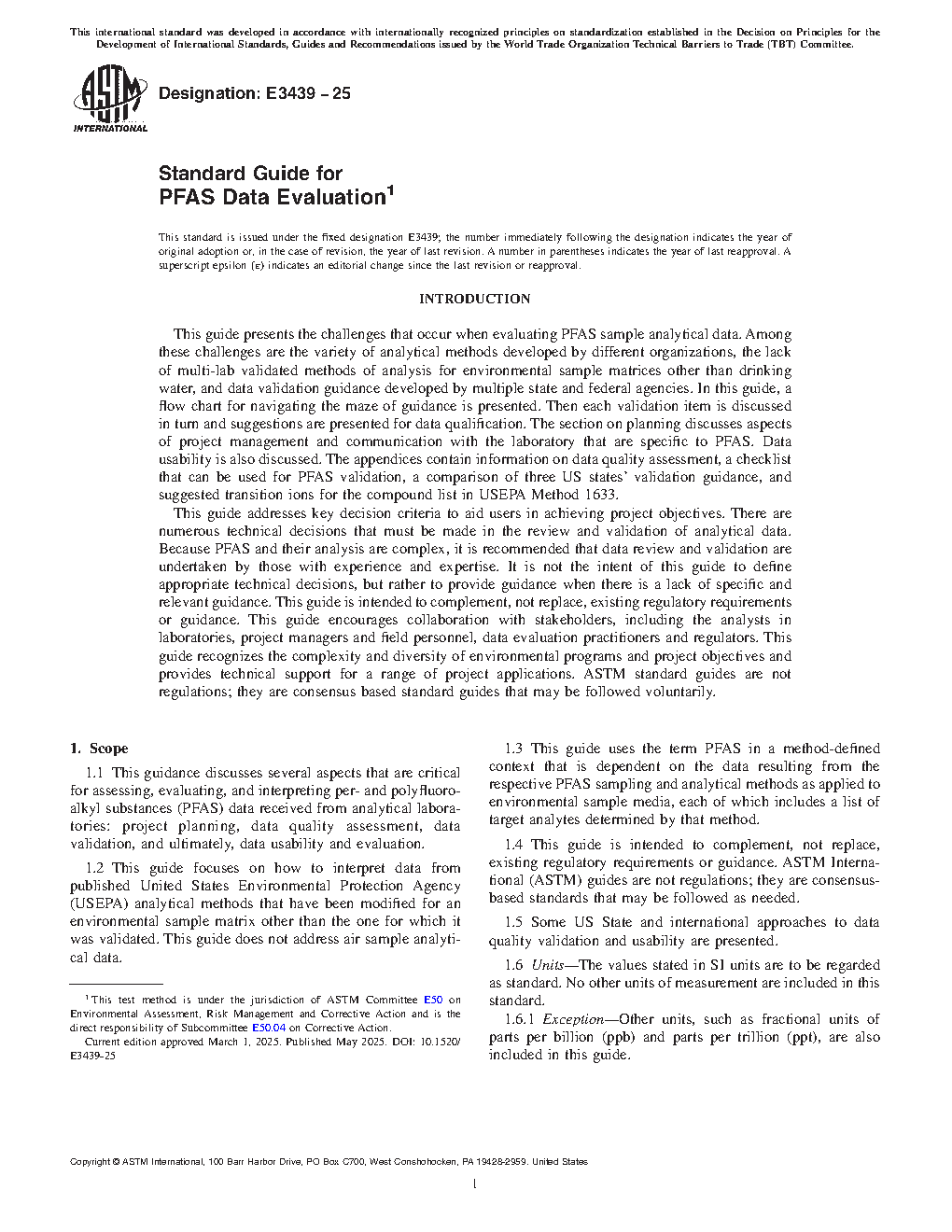
1.1 This guidance discusses several aspects that are critical for assessing, evaluating, and interpreting per- and polyfluoroalkyl substances (PFAS) data received from analytical laboratories: project planning, data quality assessment, data validation, and ultimately, data usability and evaluation.
1.2 This guide focuses on how to interpret data from published United States Environmental Protection Agency (USEPA) analytical methods that have been modified for an environmental sample matrix other than the one for which it was validated. This guide does not address air sample analytical data.
1.3 This guide uses the term PFAS in a method-defined context that is dependent on the data resulting from the respective PFAS sampling and analytical methods as applied to environmental sample media, each of which includes a list of target analytes determined by that method.
1.4 This guide is intended to complement, not replace, existing regulatory requirements or guidance. ASTM International (ASTM) guides are not regulations; they are consensus-based standards that may be followed as needed.
1.5 Some US State and international approaches to data quality validation and usability are presented.
1.6 Units—The values stated in SI units are to be regarded as standard. No other units of measurement are included in this standard.
1.6.1 Exception—Other units, such as fractional units of parts per billion (ppb) and parts per trillion (ppt), are also included in this guide.
1.7 This standard does not purport to address all of the safety concerns, if any, associated with its use. It is the responsibility of the user of this standard to establish appropriate safety, health, and environmental practices and determine the applicability of regulatory limitations prior to use.
1.8 This international standard was developed in accordance with internationally recognized principles on standardization established in the Decision on Principles for the Development of International Standards, Guides and Recommendations issued by the World Trade Organization Technical Barriers to Trade (TBT) Committee.
Significance and Use:
4.1 This guide can be used before data are collected for a PFAS sampling project to aid in planning the analysis and selecting the laboratory.
4.2 The users of this guide should consider assembling a team of experienced professionals with appropriate expertise to plan and execute PFAS data acquisition and evaluation activities.
4.3 Once the samples have been submitted and the data have been received from the laboratory, this guide will aid in interpreting the data received from the laboratory, especially when the method used for analysis is a modification of one of the USEPA drinking water methods, Methods 537.1 and 533. This guide differs from existing guidance in that international guidance is also referenced.
4.4 This guide is not intended to replace or supersede federal, state, local, or international regulatory requirements. Instead, this guide may be used to complement and support such requirements.
4.5 This guide may be used by various parties involved in response actions for PFAS-impacted environmental media, including environmental consultants and contractors, site remediation professionals, data reviewers, data users, regulatory agencies, project sponsors, analytical testing laboratories, academic institutions, research institutes, and other stakeholders.
4.6 The users of this guide should take on consideration that any analytical method applied to quantify or identify PFAS shall be restricted to use by, or under supervision of, personnel appropriately experienced and trained in the use of the specific chromatographic equipment and skilled in chromatogram and mass spectral interpretation.
4.7 The users of this guide should review the overall structure and components of this guide before proceeding with use, including the following sections:
4.7.1 Section 1: Scope
4.7.2 Section 2: Referenced Documents
4.7.3 Section 3: Terminology
4.7.4 Section 4: Signi?cance and Use
4.7.5 Section 5: Project Planning
4.7.6 Section 6: Data Validation and Evaluation
4.7.7 Section 7: Data Usability
4.7.8 Appendix X1: Example Checklist
4.7.9 Appendix X2: State Guidance
4.7.10 Appendix X3: Transition Ions
4.7.11 Appendix X4: Data Quality Assessment Considerations
Technical characteristics
| Publisher | American Society for Testing and Materials (ASTM International) |
| Publication Date | 03/01/2025 |
| Collection | |
| Page Count | 44 |
| Themes | Chemical analysis |
| EAN | --- |
| ISBN | --- |
| Weight (in grams) | --- |
Previous versions