
ASTM E3474-25
 Preview
Summary
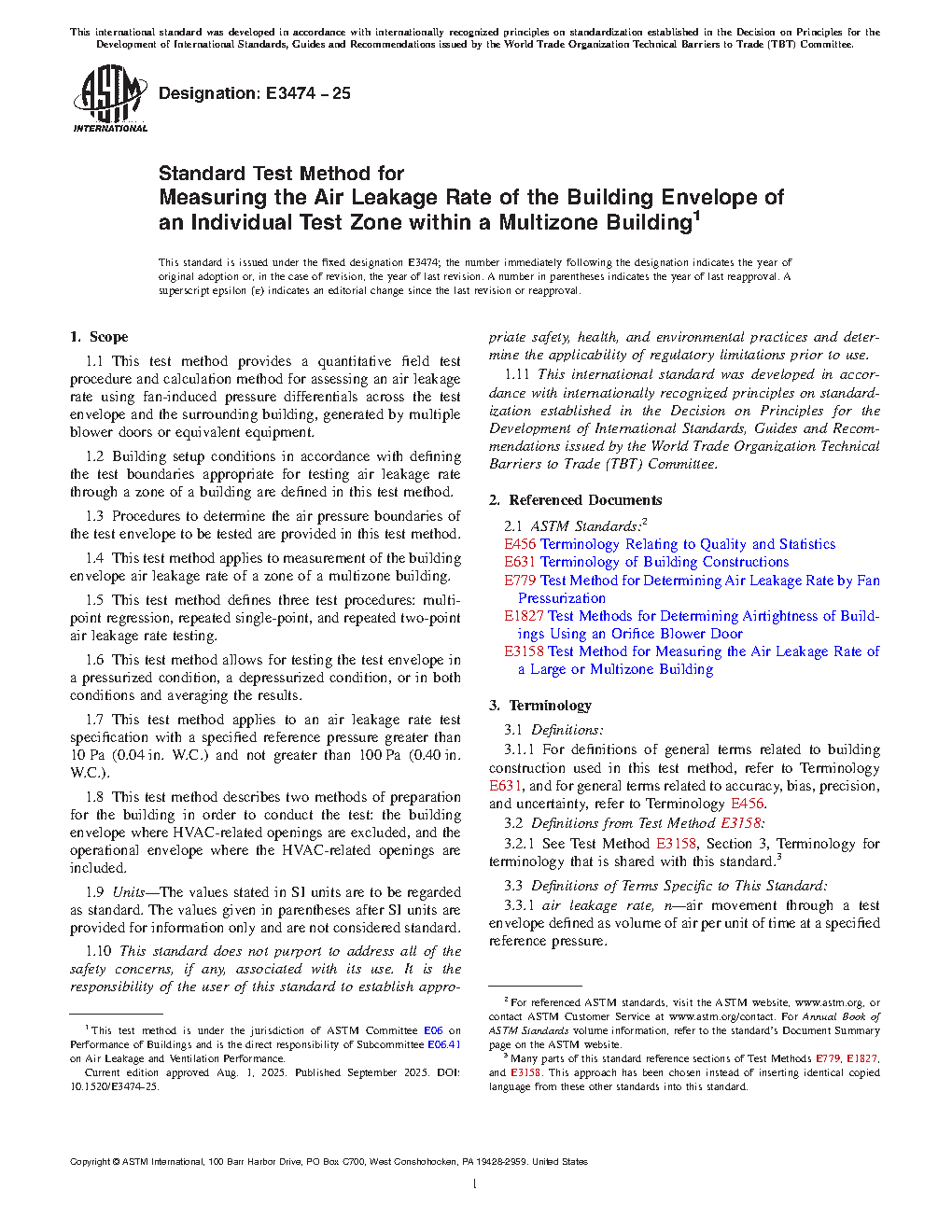
1.1 This test method provides a quantitative ?eld test procedure and calculation method for assessing an air leakage rate using fan-induced pressure differentials across the test envelope and the surrounding building, generated by multiple blower doors or equivalent equipment.
1.2 Building setup conditions in accordance with de?ning the test boundaries appropriate for testing air leakage rate through a zone of a building are de?ned in this test method.
1.3 Procedures to determine the air pressure boundaries of the test envelope to be tested are provided in this test method.
1.4 This test method applies to measurement of the building envelope air leakage rate of a zone of a multizone building.
1.5 This test method de?nes three test procedures: multi-point regression, repeated single-point, and repeated two-point air leakage rate testing.
1.6 This test method allows for testing the test envelope in a pressurized condition, a depressurized condition, or in both conditions and averaging the results.
1.7 This test method applies to an air leakage rate test speci?cation with a specified reference pressure greater than 10 Pa (0.04 in. W.C.) and not greater than 100 Pa (0.40 in. W.C.).
1.8 This test method describes two methods of preparation for the building in order to conduct the test: the building envelope where HVAC-related openings are excluded, and the operational envelope where the HVAC-related openings are included.
1.9 Units—The values stated in SI units are to be regarded as standard. The values given in parentheses after SI units are provided for information only and are not considered standard.
1.10 This standard does not purport to address all of the safety concerns, if any, associated with its use. It is the responsibility of the user of this standard to establish appropriate safety, health, and environmental practices and determine the applicability of regulatory limitations prior to use.
1.11 This international standard was developed in accordance with internationally recognized principles on standardization established in the Decision on Principles for the Development of International Standards, Guides and Recommendations issued by the World Trade Organization Technical Barriers to Trade (TBT) Committee.
Significance and Use:
5.1 The ability to accurately measure the airtightness of a portion of a building envelope is significant to diagnostic testing, compliance testing, ventilation and space conditioning load calculations, and energy modelling of discrete portions of a building.
5.2 Zonal testing is particularly useful when one or more portions of a whole building may be ready for testing, but other portions may not be fully ready, or they may not be completely available for a test due to restricted access, partial demolition, or other use of the building, or the other zones may not even require compliance testing as in the partial renovation of a large building. It may also be useful to establish that certain portions of a building are passing compliance requirements, while other portions of a building are not.
5.3 This test method is used to determine the airtightness of a portion of a building envelope by measuring the air leakage rate of the constructed envelope through a single zone of a multizone building at a specified reference pressure. Compared to a multizone building test, such as described in Test Method E3158 which accurately measures whole building airtightness, accurate measurement of the air leakage rate through an individual test zone requires closer tolerances with respect to the creation and maintenance of a balanced zone condition during air leakage rate measurements.
5.4 The building preparations prior to testing (fenestration positions and preparation of intentional openings such as HVAC penetrations equipment) are critically important and can have a strong influence on the final results. This test method will refer to Test Method E3158 for guidance for testing of the building envelope both including and excluding the HVAC-related openings.
5.5 Compliance with a specified air leakage rate does not imply that all potentially problematic leaks have been sealed.
5.6 While this test determines the air leakage rate of a constructed envelope, it does not identify the exact location of leakage sites.
Technical characteristics
| Publisher | American Society for Testing and Materials (ASTM International) |
| Publication Date | 08/01/2025 |
| Collection | |
| Page Count | 6 |
| Themes | Thermal insulation of buildings |
| EAN | --- |
| ISBN | --- |
| Weight (in grams) | --- |