ASTM E3515-25e1
 Preview
Summary
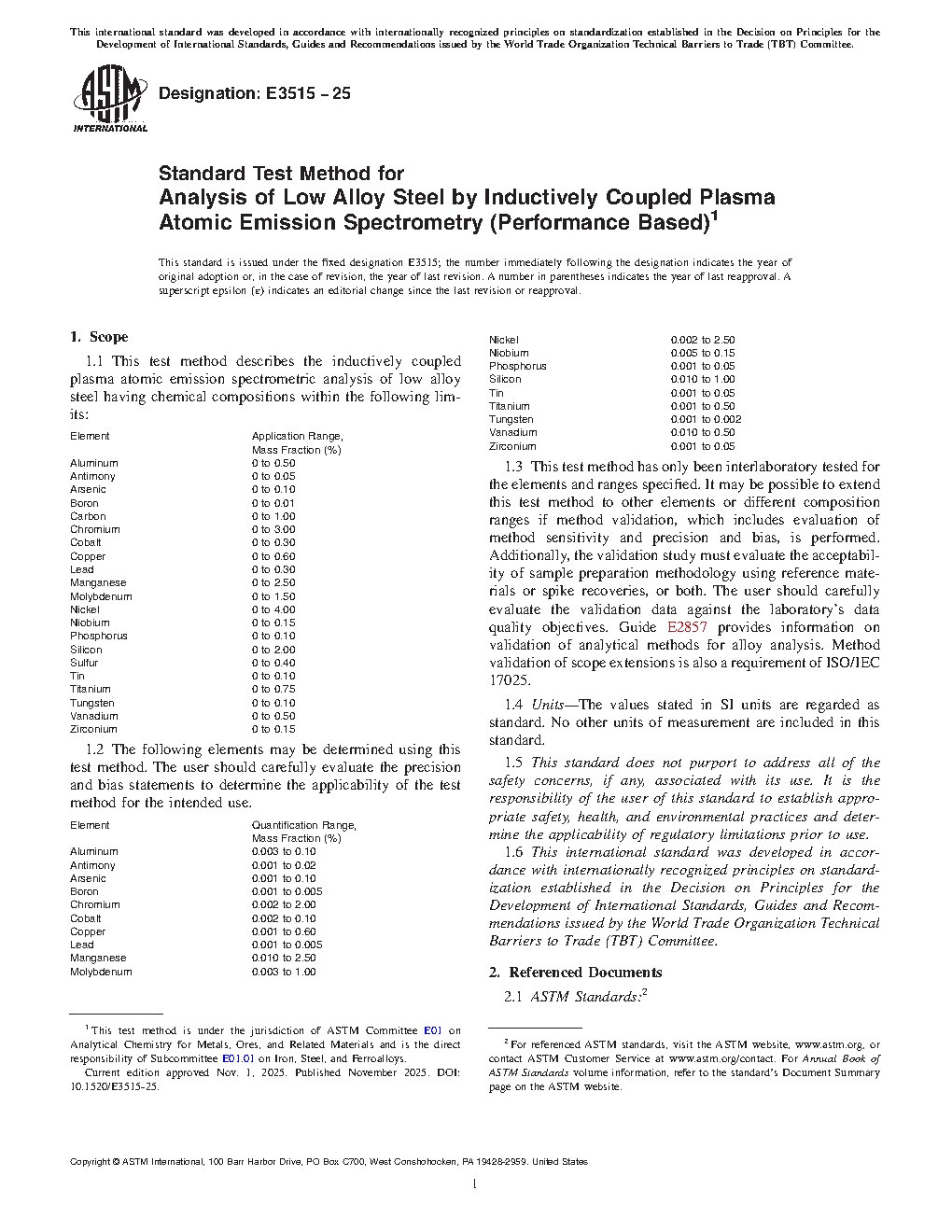
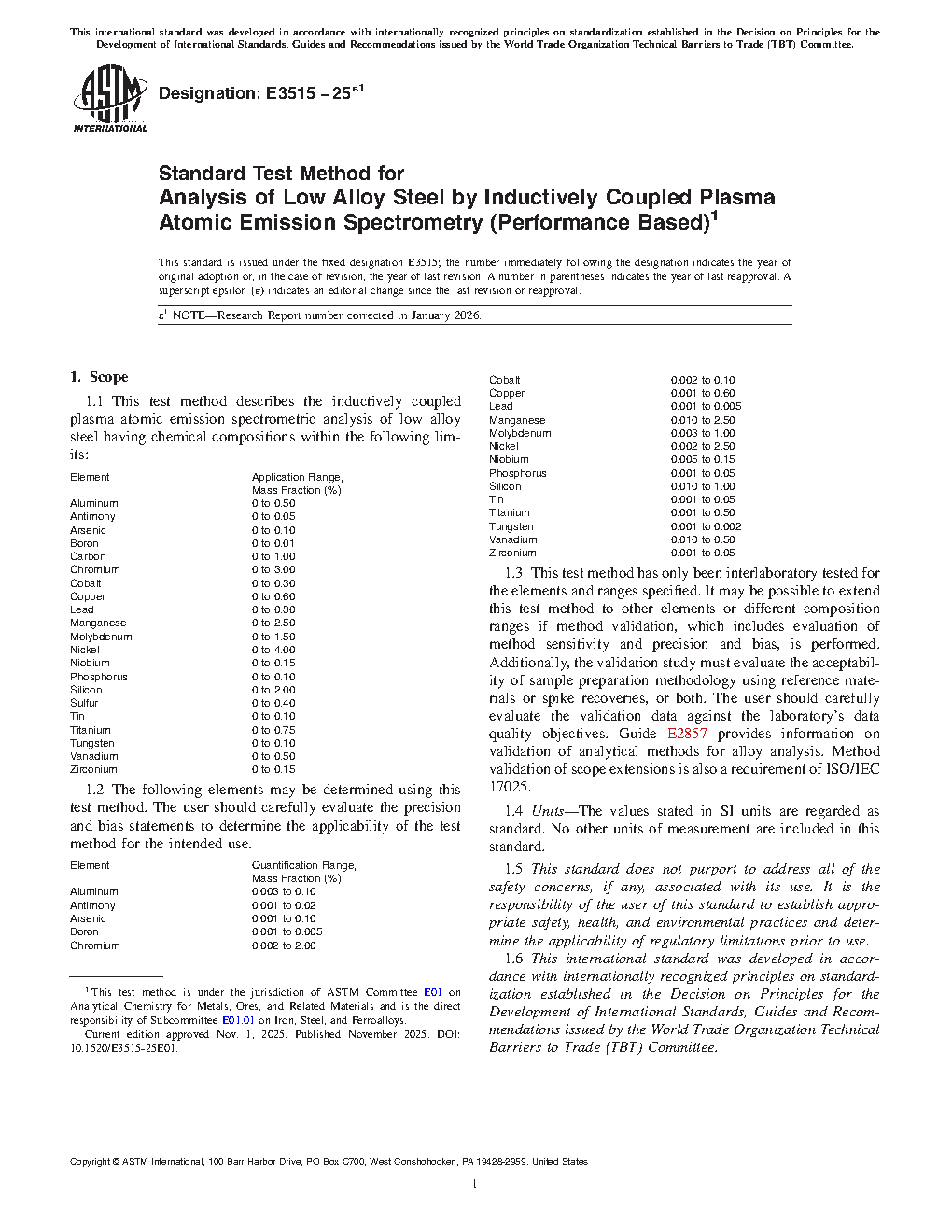
1.1 This test method describes the inductively coupled plasma atomic emission spectrometric analysis of low alloy steel having chemical compositions within the following limits:
| Element | Application Range, |
| Aluminum | 0 to 0.50 |
| Antimony | 0 to 0.05 |
| Arsenic | 0 to 0.10 |
| Boron | 0 to 0.01 |
| Carbon | 0 to 1.00 |
| Chromium | 0 to 3.00 |
| Cobalt | 0 to 0.30 |
| Copper | 0 to 0.60 |
| Lead | 0 to 0.30 |
| Manganese | 0 to 2.50 |
| Molybdenum | 0 to 1.50 |
| Nickel | 0 to 4.00 |
| Niobium | 0 to 0.15 |
| Phosphorus | 0 to 0.10 |
| Silicon | 0 to 2.00 |
| Sulfur | 0 to 0.40 |
| Tin | 0 to 0.10 |
| Titanium | 0 to 0.75 |
| Tungsten | 0 to 0.10 |
| Vanadium | 0 to 0.50 |
| Zirconium | 0 to 0.15 |
1.2 The following elements may be determined using this test method. The user should carefully evaluate the precision and bias statements to determine the applicability of the test method for the intended use.
| Element | Quanti?cation Range, |
| Aluminum | 0.003 to 0.10 |
| Antimony | 0.001 to 0.02 |
| Arsenic | 0.001 to 0.10 |
| Boron | 0.001 to 0.005 |
| Chromium | 0.002 to 2.00 |
| Cobalt | 0.002 to 0.10 |
| Copper | 0.001 to 0.60 |
| Lead | 0.001 to 0.005 |
| Manganese | 0.010 to 2.50 |
| Molybdenum | 0.003 to 1.00 |
| Nickel | 0.002 to 2.50 |
| Niobium | 0.005 to 0.15 |
| Phosphorus | 0.001 to 0.05 |
| Silicon | 0.010 to 1.00 |
| Tin | 0.001 to 0.05 |
| Titanium | 0.001 to 0.50 |
| Tungsten | 0.001 to 0.002 |
| Vanadium | 0.010 to 0.50 |
| Zirconium | 0.001 to 0.05 |
1.3 This test method has only been interlaboratory tested for the elements and ranges specified. It may be possible to extend this test method to other elements or different composition ranges if method validation, which includes evaluation of method sensitivity and precision and bias, is performed. Additionally, the validation study must evaluate the acceptability of sample preparation methodology using reference materials or spike recoveries, or both. The user should carefully evaluate the validation data against the laboratory’s data quality objectives. Guide E2857 provides information on validation of analytical methods for alloy analysis. Method validation of scope extensions is also a requirement of ISO/IEC 17025.
1.4 Units—The values stated in SI units are regarded as standard. No other units of measurement are included in this standard.
1.5 This standard does not purport to address all of the safety concerns, if any, associated with its use. It is the responsibility of the user of this standard to establish appropriate safety, health, and environmental practices and determine the applicability of regulatory limitations prior to use.
1.6 This international standard was developed in accordance with internationally recognized principles on standardization established in the Decision on Principles for the Development of International Standards, Guides and Recommendations issued by the World Trade Organization Technical Barriers to Trade (TBT) Committee.
Significance and Use:
5.1 This test method for the chemical analysis of low alloy steel is primarily intended to test such materials for compliance with compositional specifications.
5.2 It is assumed that all who use this test method will be trained analysts capable of performing common laboratory procedures skillfully and safely and that the work will be performed in a properly equipped laboratory.
5.3 This is a performance based test method that relies more on the demonstrated quality of the test results than on strict adherence to specific procedural steps. It is expected that laboratories using this test method will prepare their own laboratory analysis procedures. These procedures will include detailed operating instructions for the specific laboratory, the specific reference materials used, and performance acceptance criteria. It is also expected that, when applicable, each laboratory will participate in proficiency test programs, such as described in Practice E2027, and that the results from the participating laboratory will be satisfactory.
Technical characteristics
| Publisher | American Society for Testing and Materials (ASTM International) |
| Publication Date | 11/01/2025 |
| Collection | |
| Page Count | 11 |
| Themes | Physicochemical methods of analysis |
| EAN | --- |
| ISBN | --- |
| Weight (in grams) | --- |
Replaces
Previous versions