
ASTM F3284-25
 Preview
Summary
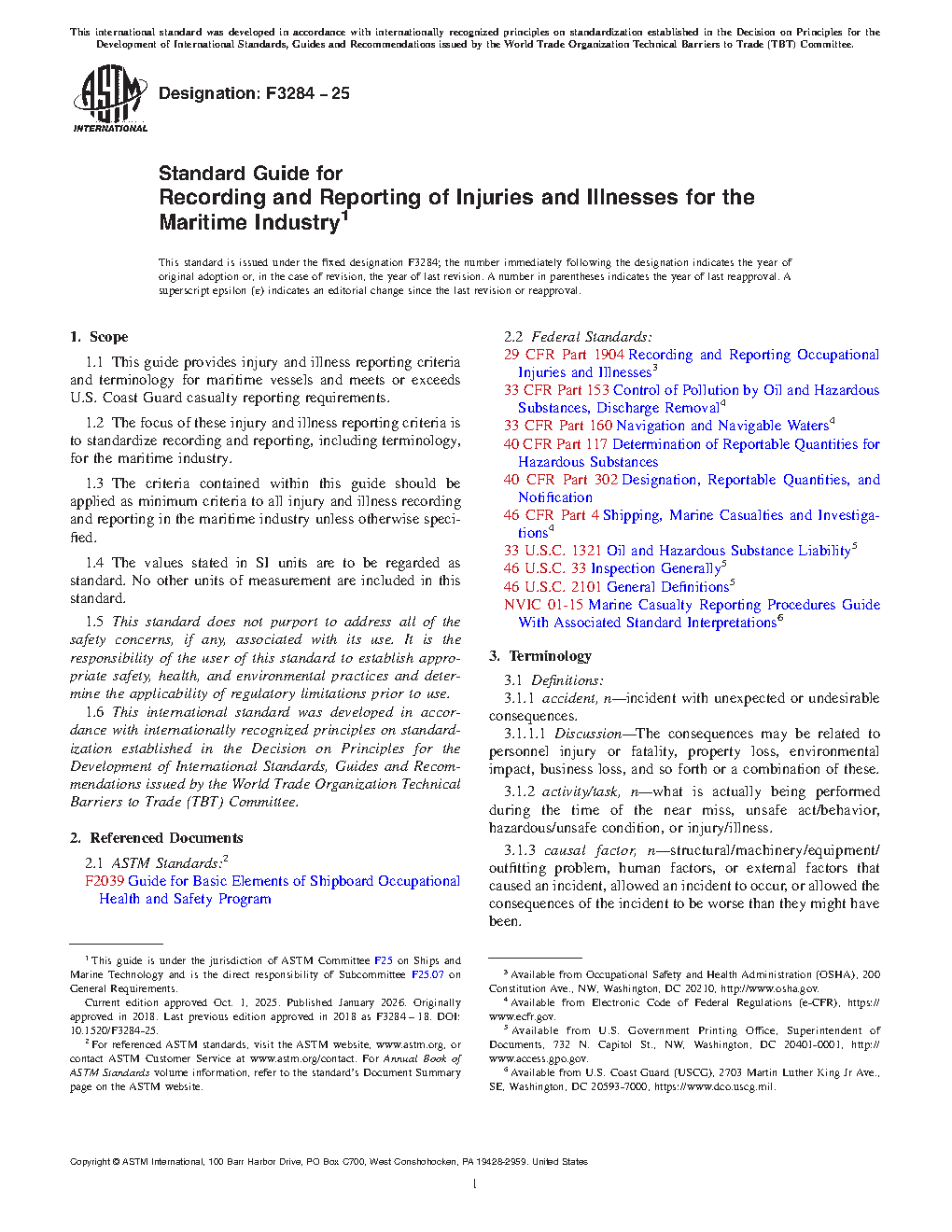
1.1 This guide provides injury and illness reporting criteria and terminology for maritime vessels and meets or exceeds U.S. Coast Guard casualty reporting requirements.
1.2 The focus of these injury and illness reporting criteria is to standardize recording and reporting, including terminology, for the maritime industry.
1.3 The criteria contained within this guide should be applied as minimum criteria to all injury and illness recording and reporting in the maritime industry unless otherwise specified.
1.4 The values stated in SI units are to be regarded as standard. No other units of measurement are included in this standard.
1.5 This standard does not purport to address all of the safety concerns, if any, associated with its use. It is the responsibility of the user of this standard to establish appropriate safety, health, and environmental practices and determine the applicability of regulatory limitations prior to use.
1.6 This international standard was developed in accordance with internationally recognized principles on standardization established in the Decision on Principles for the Development of International Standards, Guides and Recommendations issued by the World Trade Organization Technical Barriers to Trade (TBT) Committee.
Significance and Use:
5.1 This guide provides best practices for the recording and reporting of maritime injuries and illnesses and those included in 46 CFR Part 4.03-1.
5.2 Each maritime organization should record and report each reportable marine casualty or accident in a manner that meets or exceeds regulations set forth by 46 CFR Part 4.03-1 and the Department of Homeland Security, USCG Report of Marine Casualty (CG-2692).
5.2.1 Marine Casualty or Accident—Some incidents defined as a “marine casualty or accident” per 46 CFR Part 4.03-1 will not meet the criteria in 46 CFR Part 4.05-1(a) requiring initial reporting and Form CG-2692 submissions to the USCG. However, owners, agents, masters, operators, or persons in charge need to consider whether notification to the USCG is still required under other regulations, including 33 CFR Part 160.216, for the reporting of a hazardous condition.
5.2.2 As a best practice supplement to 46 CFR Part 4.05-1, each maritime organization should record and report each injury or illness that meets one or more of the following criteria:
5.2.2.1 Medical treatment beyond first aid,
5.2.2.2 Restricted work or transfer to another job,
5.2.2.3 Days away from work,
5.2.2.4 Loss of consciousness,
5.2.2.5 Death, and
5.2.2.6 A significant injury or illness diagnosed by a physician or other licensed health care professional.
5.2.3 Each maritime organization should record and report to management all injuries requiring only first aid and incidents resulting in near-misses.
5.2.4 The vessel owner, agent, master, operator, or person in charge shall complete the CG-2692 form as required by the USCG and are encouraged to record the supplemental fields included in this guide. This form should be completed as completely and accurately as possible. Fill in all blanks that apply to the kind of incident that occurred. If a question is not applicable, the abbreviation “NA” should be entered in that space. If an answer is unknown and cannot be obtained, the abbreviation “UNK” should be entered in that space. If “NONE” is the correct response, then enter it in that space.
5.2.5 Once the form is completed, and if the incident meets the USCG reporting threshold outlined in 46 CFR Part 4.05, deliver, e-mail, or fax this form within five days of the casualty to the USCG sector, marine safety unit, or activity nearest the location of the casualty or, if at sea, nearest arrival point.
5.2.6 When a casualty meets the requirements of a serious marine incident as defined in 46 CFR Part 4.03, the owner, agent, master, operator, or person in charge is also required to submit a CG-2692B in accordance with 46 CFR Part 4.06-60.
5.2.7 Example best practice injury/illness recording/reporting fields that supplement the required CG-2692 are provided in Appendix X2. These fields also satisfy the best practices set forth in this guide and are intended to enhance the value of injury and illness recording/reporting through higher quality and consistency of the data. The intention is that higher quality and consistent data may lead to improved corrective action development, lessons learned discrimination, and industry benchmarking. Appendix X2 is not intended to replace the regulatory requirements of CG-2692, but it does contain some over-lapping fields.
Technical characteristics
| Publisher | American Society for Testing and Materials (ASTM International) |
| Publication Date | 10/01/2025 |
| Collection | |
| Page Count | 14 |
| Themes | Accident and disaster control |
| EAN | --- |
| ISBN | --- |
| Weight (in grams) | --- |
Replaces

Previous versions