
ASTM F3772-25
 Preview
Summary
1.1 Purpose:
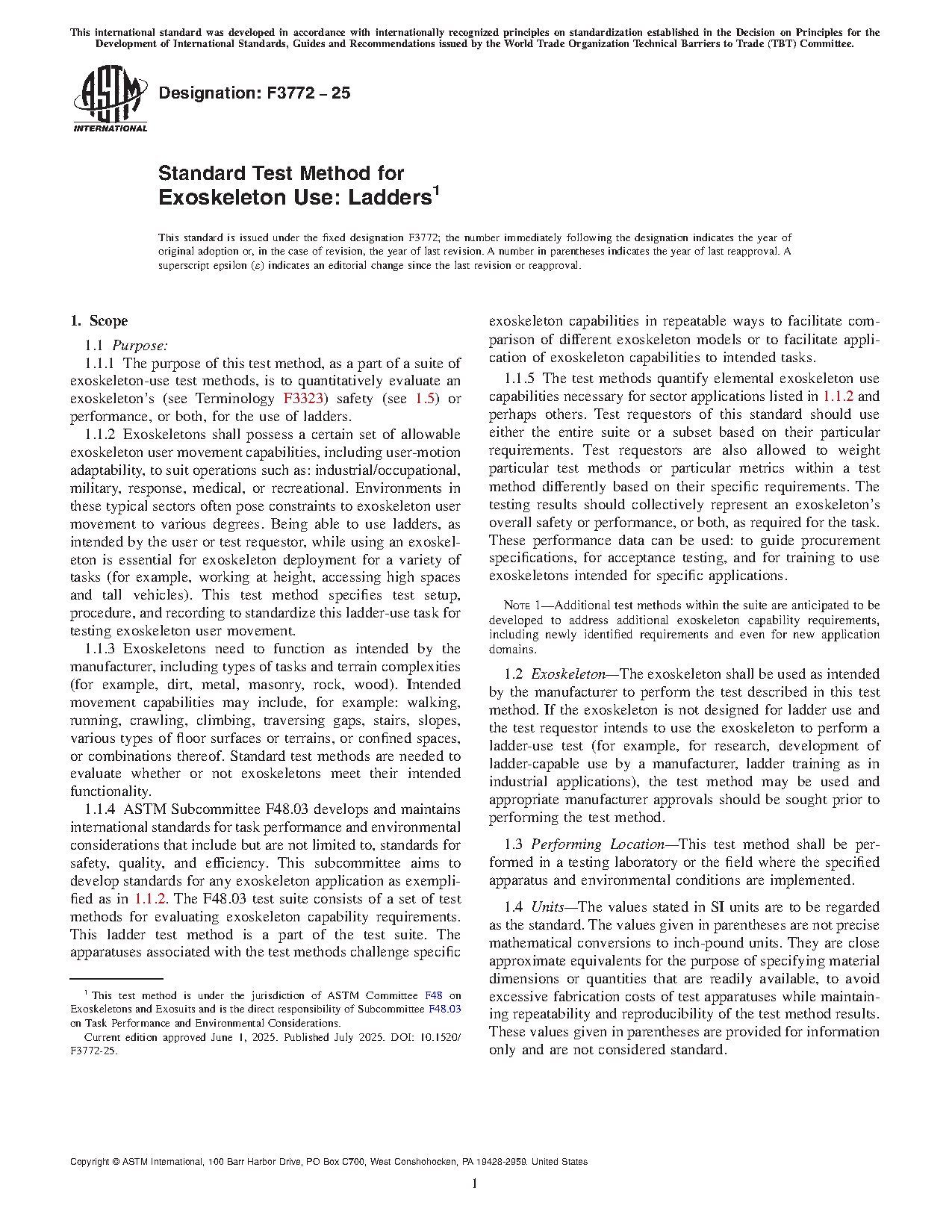
1.1.1 The purpose of this test method, as a part of a suite of exoskeleton-use test methods, is to quantitatively evaluate an exoskeleton’s (see Terminology F3323) safety (see 1.5) or performance, or both, for the use of ladders.
1.1.2 Exoskeletons shall possess a certain set of allowable exoskeleton user movement capabilities, including user-motion adaptability, to suit operations such as: industrial/occupational, military, response, medical, or recreational. Environments in these typical sectors often pose constraints to exoskeleton user movement to various degrees. Being able to use ladders, as intended by the user or test requestor, while using an exoskeleton is essential for exoskeleton deployment for a variety of tasks (for example, working at height, accessing high spaces and tall vehicles). This test method specifies test setup, procedure, and recording to standardize this ladder-use task for testing exoskeleton user movement.
1.1.3 Exoskeletons need to function as intended by the manufacturer, including types of tasks and terrain complexities (for example, dirt, metal, masonry, rock, wood). Intended movement capabilities may include, for example: walking, running, crawling, climbing, traversing gaps, stairs, slopes, various types of floor surfaces or terrains, or confined spaces, or combinations thereof. Standard test methods are needed to evaluate whether or not exoskeletons meet their intended functionality.
1.1.4 ASTM Subcommittee F48.03 develops and maintains international standards for task performance and environmental considerations that include but are not limited to, standards for safety, quality, and efficiency. This subcommittee aims to develop standards for any exoskeleton application as exemplified as in 1.1.2. The F48.03 test suite consists of a set of test methods for evaluating exoskeleton capability requirements. This ladder test method is a part of the test suite. The apparatuses associated with the test methods challenge specific exoskeleton capabilities in repeatable ways to facilitate comparison of different exoskeleton models or to facilitate application of exoskeleton capabilities to intended tasks.
1.1.5 The test methods quantify elemental exoskeleton use capabilities necessary for sector applications listed in 1.1.2 and perhaps others. Test requestors of this standard should use either the entire suite or a subset based on their particular requirements. Test requestors are also allowed to weight particular test methods or particular metrics within a test method differently based on their specific requirements. The testing results should collectively represent an exoskeleton’s overall safety or performance, or both, as required for the task. These performance data can be used: to guide procurement specifications, for acceptance testing, and for training to use exoskeletons intended for specific applications.
Note 1: Additional test methods within the suite are anticipated to be developed to address additional exoskeleton capability requirements, including newly identified requirements and even for new application domains.
1.2 Exoskeleton—The exoskeleton shall be used as intended by the manufacturer to perform the test described in this test method. If the exoskeleton is not designed for ladder use and the test requestor intends to use the exoskeleton to perform a ladder-use test (for example, for research, development of ladder-capable use by a manufacturer, ladder training as in industrial applications), the test method may be used and appropriate manufacturer approvals should be sought prior to performing the test method.
1.3 Performing Location—This test method shall be performed in a testing laboratory or the field where the specified apparatus and environmental conditions are implemented.
1.4 Units—The values stated in SI units are to be regarded as the standard. The values given in parentheses are not precise mathematical conversions to inch-pound units. They are close approximate equivalents for the purpose of specifying material dimensions or quantities that are readily available, to avoid excessive fabrication costs of test apparatuses while maintaining repeatability and reproducibility of the test method results. These values given in parentheses are provided for information only and are not considered standard.
1.5 This standard does not purport to address all of the safety concerns, if any, associated with its use. It is the responsibility of the user of this standard to establish appropriate safety, health, and environmental practices and determine the applicability of regulatory limitations prior to use.
1.6 This international standard was developed in accordance with internationally recognized principles on standardization established in the Decision on Principles for the Development of International Standards, Guides and Recommendations issued by the World Trade Organization Technical Barriers to Trade (TBT) Committee.
Significance and Use:
5.1 Ladder designs can vary greatly in, for example: number and size of steps, geometry, and materials, and for a variety of industries. Fig. 2 shows examples of various ladders.
5.2.1 Example—A test requestor instructs that a lower-body exoskeleton is to be worn by five able-bodied users who are to complete 29 full tests to ascend and descend the standard ladder apparatus at their own pace where environmental variables are similar for all users. Upon testing, each user performed all 29 full tests which, from Appendix X1, Table X1.1, produces 90 % probability of success threshold and 95 % associated confidence with zero failures for all five users.
5.3 This test method addresses exoskeleton safety and performance requirements expressed by manufacturing, emergency responders, military, or other organizations requesting this test. The safety and performance data captured within this test method are indicative of the exoskeleton’s and the exoskeleton user’s capabilities. Having available direct information from tested exoskeleton(s) with associated performance data to guide procurement and deployment decisions is essential to exoskeleton purchasers and users.
5.4 The testing results of the candidate exoskeleton(s) shall describe, in a statistically significant way, how reliably the exoskeleton user is able to negotiate a ladder. The test apparatus described in Section 6 is intended to be a single, standardized ladder where repeatable results between exoskeletons, users, and organizations are comparable. The standard test setup and apparatus can also be used to support training and establish proficiency of exoskeleton users, as well as provide manufacturers with information about the usefulness of their exoskeleton(s) for tasks. For guidance on exoskeleton training, see Practice F3444/F3444M.
5.5 Although the test method was developed for the sectors listed in 5.2, it may be applicable to other operational domains.
Technical characteristics
| Publisher | American Society for Testing and Materials (ASTM International) |
| Publication Date | 06/01/2025 |
| Collection | |
| Page Count | 14 |
| Themes | Manipulators |
| EAN | --- |
| ISBN | --- |
| Weight (in grams) | --- |
Previous versions