
Superseded
Draft standard
Historical
DIN EN ISO 17201-3:2018-12
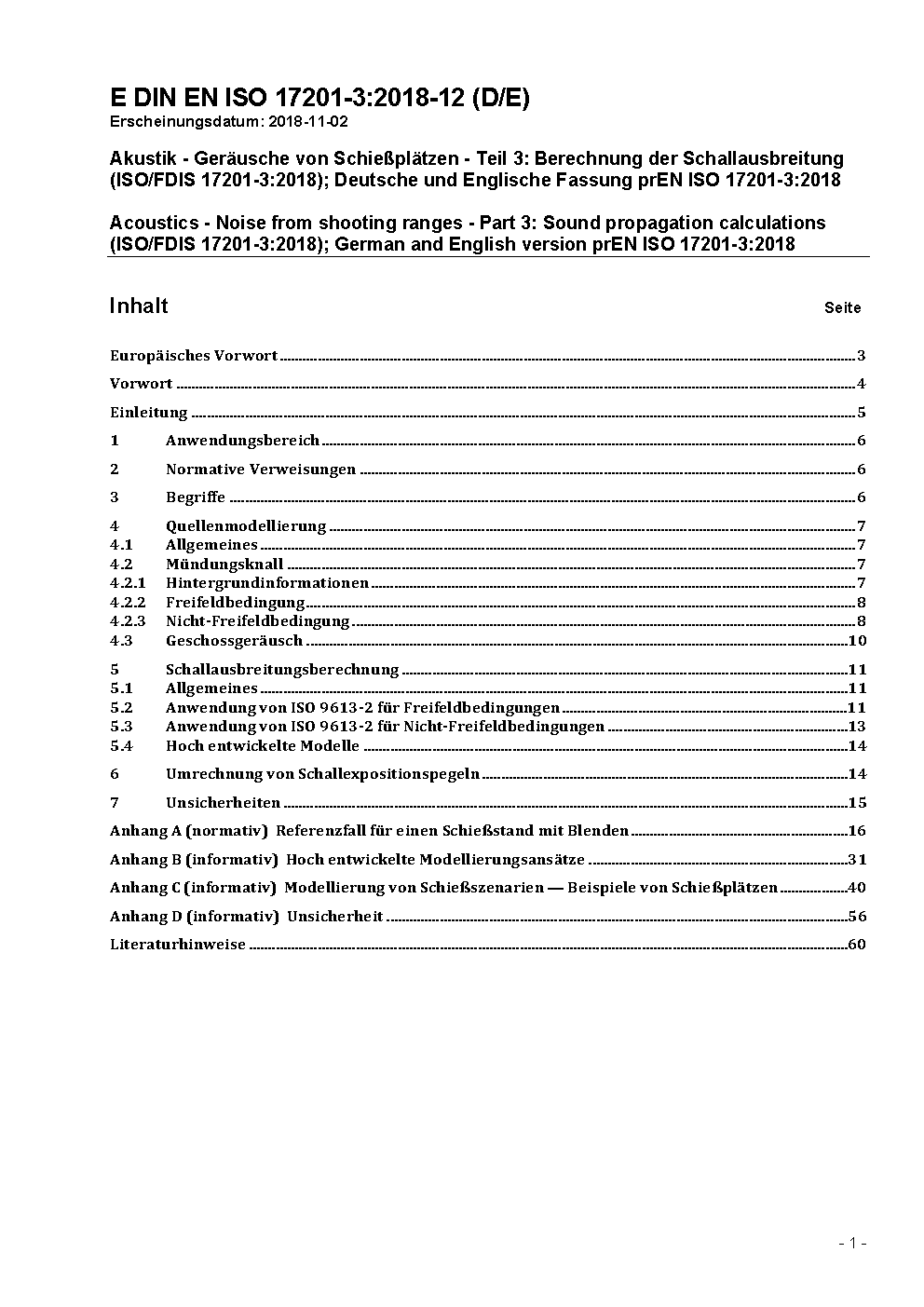
Acoustics - Noise from shooting ranges - Part 3: Sound propagation calculations (ISO/FDIS 17201-3:2018); German and English version prEN ISO 17201-3:2018
 Preview
Summary
This document provides for the user specifications and recommendations for calculating sound propagation of shooting sound from shooting ranges. It is only applicable if corresponding calculation procedures are not specified by local or national rules and regulations. If that is given and if a more sophisticated propagation model is not available, then ISO 9613-2 may be applied, provided that the recommendations laid down in this document are observed. The purpose of this document is to predict sound exposure levels of shooting sound for shots at certain receiver points. The prediction is based on the angular source energy distribution of the muzzle blast as defined in ISO 17201-1 by means of measurement or in ISO 17201-2 by means of calculation. This document covers weapons with calibres of less than 20 mm or explosive charges of less than 50 g TNT equivalent, takes the projectile sound into account and is applicable at distances where the peak pressures and the peak pressure level are less than 1 kPa or 154 dB, respectively. The source energy of muzzle blast is typically measured or calculated for free field conditions and exhibits often strong directivity. In many cases fire arms are fired within a shooting range which has structures such as firing sheds, walls or safety barriers. Guns, particularly shot guns, are sometimes fired in many directions, for example in trap and skeet where the shooting direction is dictated by the flight path of the clay target. This document recommends ways for dealing with such scenarios and which source data can be adapted for use with ISO 9613-2 to obtain a general survey for the sound levels to be expected in the neighbourhood around shooting ranges. For the non-open field situation more sophisticated calculation models - compared to ISO 9613-2 - are applied. Part 3 recommends the use of the boundary element methods (BEM), ray tracing models, wave models or combinations in which reflection, diffraction and scattering can be taken into account in more detail. In part 3 a bench mark case based on BEM has been specified. The user of part 3 has to ensure in any case, where a sophisticated calculation model for shooting noise is used, that the sound exposure levels of the bench mark case are reproduced by the levels of his model without significant deviations. Specifications and recommendations of corresponding calculations procedures are completed by several examples and by rules for dealing with the uncertainty.
Notes
Prévu pour remplacer DIN EN ISO 17201-3 (2010-06).
Technical characteristics
| Publisher | Deutsche Institut für Normung e.V. (DIN) |
| Publication Date | 12/01/2018 |
| Page Count | 126 |
| EAN | --- |
| ISBN | --- |
| Weight (in grams) | --- |
No products.
Previous versions