Active
Standard
Most Recent
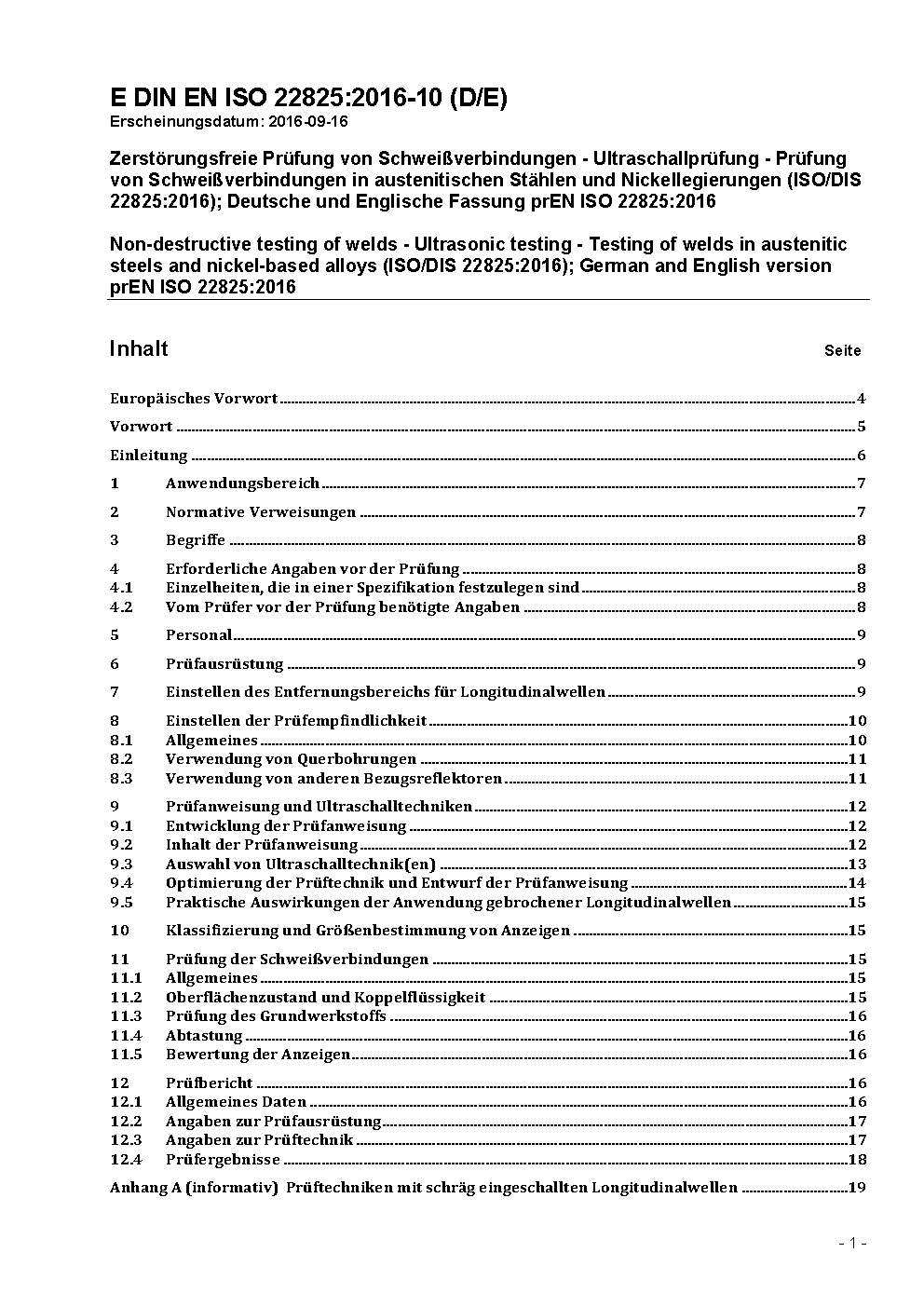
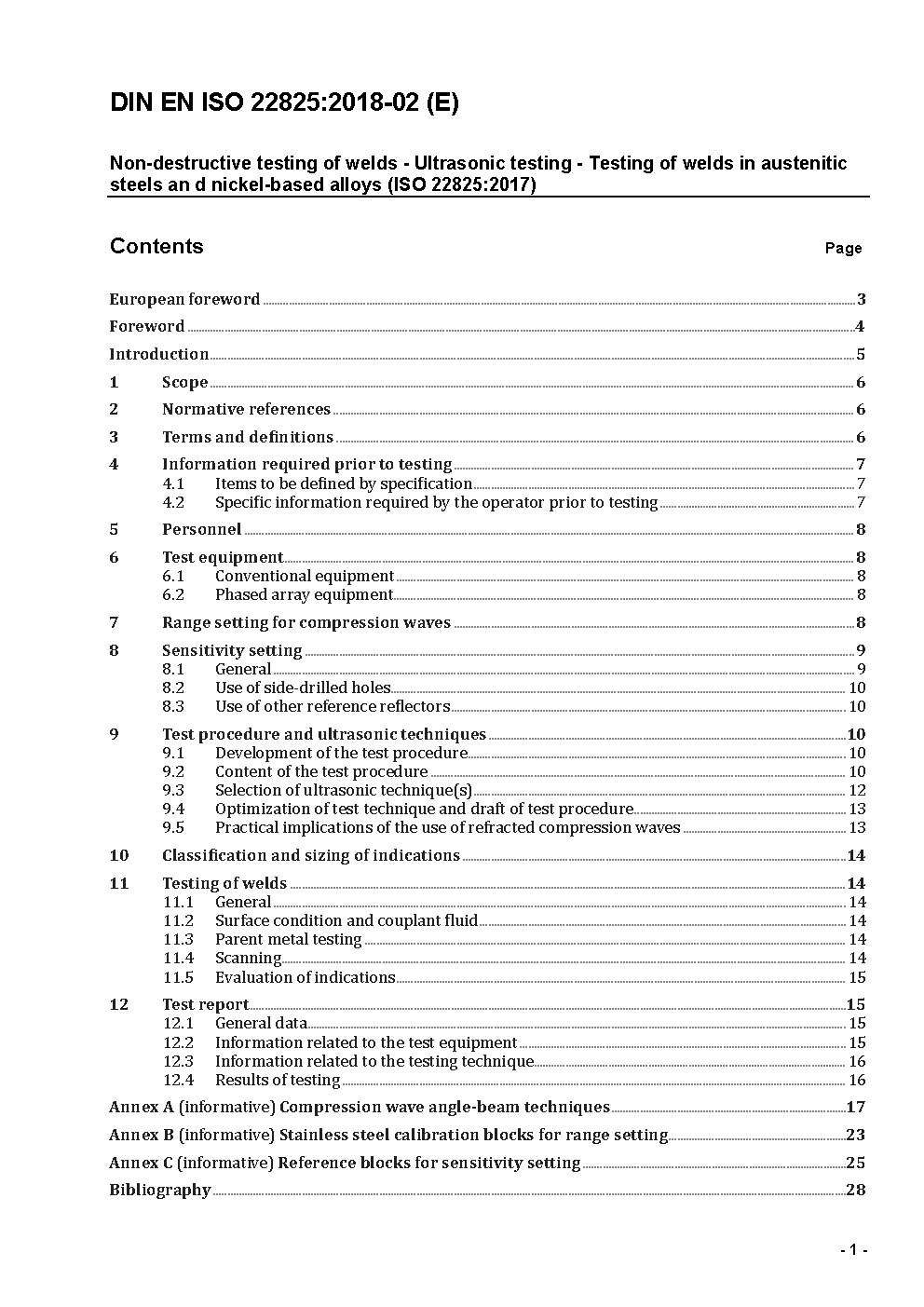
DIN EN ISO 22825:2018-02
Non-destructive testing of welds - Ultrasonic testing - Testing of welds in austenitic steels and nickel-based alloys (ISO 22825:2017); German version EN ISO 22825:2017
 Preview
Summary
Welds in austenitic steel components and dissimilar metal welds are widely regarded as very difficult to test by ultrasound. The problems are mainly associated with unfavourable structure and grain size, as well as with different material properties which result in inhomogeneous and anisotropic mechanical and acoustic properties that contrast with the relatively homogeneous and isotropic behaviour in low-alloy steel welds. Austenitic weld metal and other coarse-grained, anisotropic materials can significantly affect the propagation of ultrasound. In addition, beam distortion, unexpected reflections and wave mode conversions on the fusion line and/or columnar grains can occur. Therefore it can be difficult and sometimes impossible for ultrasonic waves to penetrate the weld metal. Ultrasonic testing of these metals may require techniques that differ from conventional testing techniques. These special techniques often include the use of dual-element probes designed for refracted compression (longitudinal) waves or creeping waves rather than for conventional shear (transverse) waves. In addition, it is necessary to produce representative reference blocks with welds in order to develop a testing procedure, set a preliminary sensitivity level, assess the procedure and demonstrate effectiveness before a definitive procedure is written. Material, weld preparation and welding procedure, as well as the geometry and surface condition of reference blocks are the same as for the component being tested.
Technical characteristics
| Publisher | Deutsche Institut für Normung e.V. (DIN) |
| Publication Date | 02/01/2018 |
| Page Count | 34 |
| EAN | --- |
| ISBN | --- |
| Weight (in grams) | --- |
No products.
Previous versions