Withdrawn
, Reaffirmed
Standard
Most Recent
IEEE 1129:1992 (R1998)
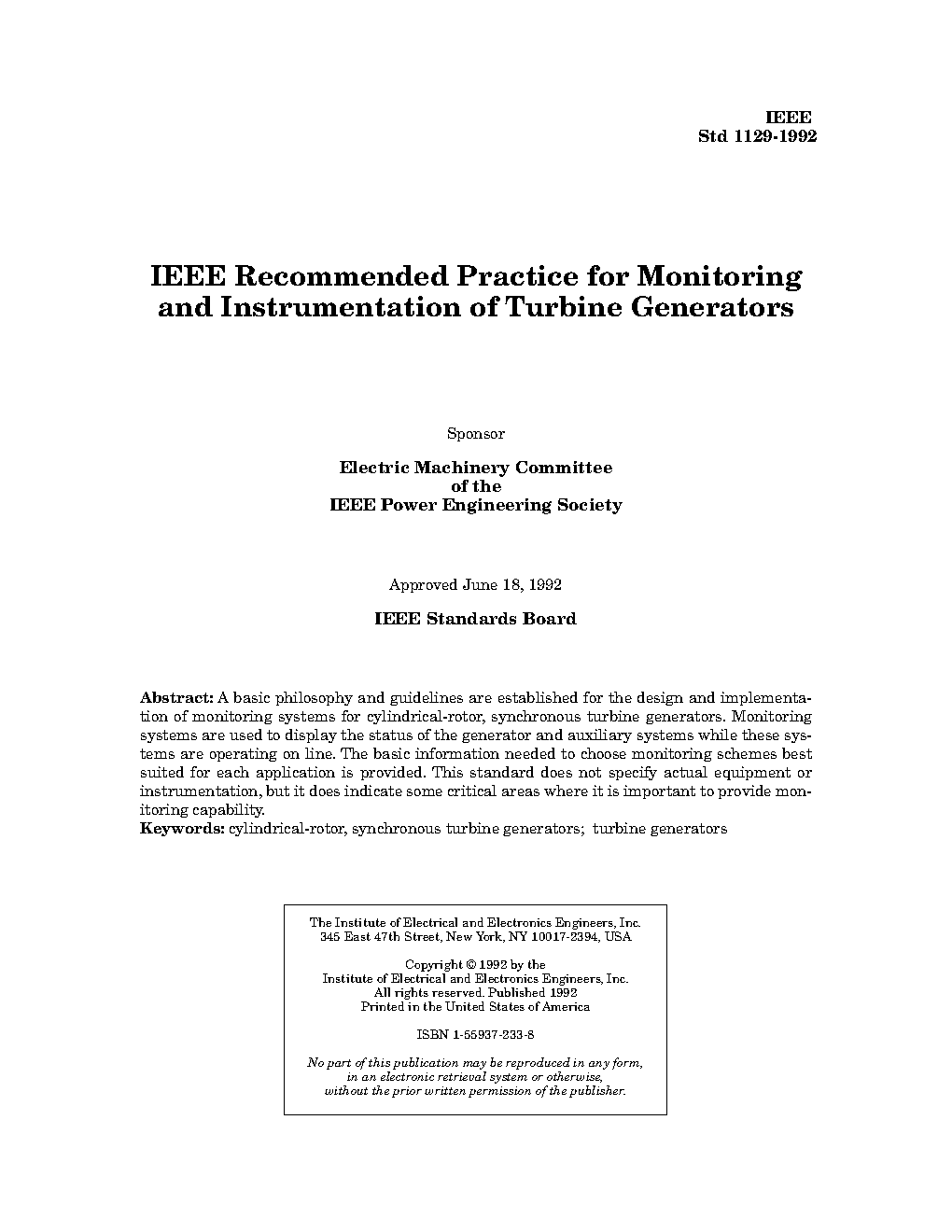
IEEE Recommended Practice for Monitoring and Instrumentation of Turbine Generators
 Preview
Summary
New IEEE Standard - Inactive-Withdrawn.
A basic philosophy and guidelines are established for the design and implementation of monitoring systems for cylindrical-rotor, synchronous turbine generators. Monitoring systems are used to display the status of the generator and auxiliary systems while these systems are operating on line. The basic information needed to choose monitoring schemes best suited for each application is provided. This standard does not specify actual equipment or instrumentation, but it does indicate some critical areas where it is important to provide monitoring capability
This document is intended to establish a basic philosophy and guidelines for the design and implementation of monitoring systems for cylindrical rotor, synchronous turbine generators. Monitoring systems are used to display the status of the generator and auxiliary systems while these systems are operating on line. This document does not specify actual equipment or instrumentation, but it does indicate some critical areas where it is important to provide monitoring capability.
Generator-protection techniques are not discussed in this document. There is a fine line of
distinction between instrumentation that is used for monitoring and instrumentation used for
protection, and there are many instruments that play a dual role.
The purpose of monitoring is to provide information to the operator to guide appropriate
action. This action may be maintenance planning, maintaining load, tripping the unit, or load
reduction. The key distinction between monitoring and protection is that with monitoring, the
action taken (if any) is not automatic but is initiated by the operator. Some users may choose
to include some of the items listed here as part of the generator-protection scheme.
Monitoring of basic generator parameters is routinely performed on commercial generators.
It is only recently, however, that the economics of power generation has created the need,
and advancing technology provided the ability, to monitor nearly all aspects of generator operation.
This should allow the operation of large-capacity machines with increased reliability and availability and with reduced downtime for outages. However, care must be exercised to avoid “overmonitoring.” While there is no doubt that great quantities of data may be useful to review when (and if) time permits, the operator should not be subjected to an overload of unessential data. The use of diagnostic systems may facilitate handling of multitudinous data
to assist the operator.
This document provides the basic information needed to choose the monitoring schemes that are best suited for each application. Not all items discussed in this document are necessary for all generators. Some users may wish to add additional monitoring systems beyond those presented in this document. The user should refer to the manufacturer’s monitoring recommendations
A basic philosophy and guidelines are established for the design and implementation of monitoring systems for cylindrical-rotor, synchronous turbine generators. Monitoring systems are used to display the status of the generator and auxiliary systems while these systems are operating on line. The basic information needed to choose monitoring schemes best suited for each application is provided. This standard does not specify actual equipment or instrumentation, but it does indicate some critical areas where it is important to provide monitoring capability
This document is intended to establish a basic philosophy and guidelines for the design and implementation of monitoring systems for cylindrical rotor, synchronous turbine generators. Monitoring systems are used to display the status of the generator and auxiliary systems while these systems are operating on line. This document does not specify actual equipment or instrumentation, but it does indicate some critical areas where it is important to provide monitoring capability.
Generator-protection techniques are not discussed in this document. There is a fine line of
distinction between instrumentation that is used for monitoring and instrumentation used for
protection, and there are many instruments that play a dual role.
The purpose of monitoring is to provide information to the operator to guide appropriate
action. This action may be maintenance planning, maintaining load, tripping the unit, or load
reduction. The key distinction between monitoring and protection is that with monitoring, the
action taken (if any) is not automatic but is initiated by the operator. Some users may choose
to include some of the items listed here as part of the generator-protection scheme.
Monitoring of basic generator parameters is routinely performed on commercial generators.
It is only recently, however, that the economics of power generation has created the need,
and advancing technology provided the ability, to monitor nearly all aspects of generator operation.
This should allow the operation of large-capacity machines with increased reliability and availability and with reduced downtime for outages. However, care must be exercised to avoid “overmonitoring.” While there is no doubt that great quantities of data may be useful to review when (and if) time permits, the operator should not be subjected to an overload of unessential data. The use of diagnostic systems may facilitate handling of multitudinous data
to assist the operator.
This document provides the basic information needed to choose the monitoring schemes that are best suited for each application. Not all items discussed in this document are necessary for all generators. Some users may wish to add additional monitoring systems beyond those presented in this document. The user should refer to the manufacturer’s monitoring recommendations
Notes
Inactive-Withdrawn
Technical characteristics
| Publisher | Institute of Electrical and Electronics Engineers (IEEE) |
| Publication Date | 12/02/1992 |
| Confirmation Date | 11/24/1998 |
| Cancellation Date | 01/16/2004 |
| Edition | |
| Page Count | 27 |
| EAN | --- |
| ISBN | --- |
| Weight (in grams) | --- |
| Brochures |

|
No products.
Previous versions
11/04/2014
Withdrawn
Most Recent
02/12/1992
Withdrawn
, Reaffirmed
Most Recent