
Active
Standard
Most Recent
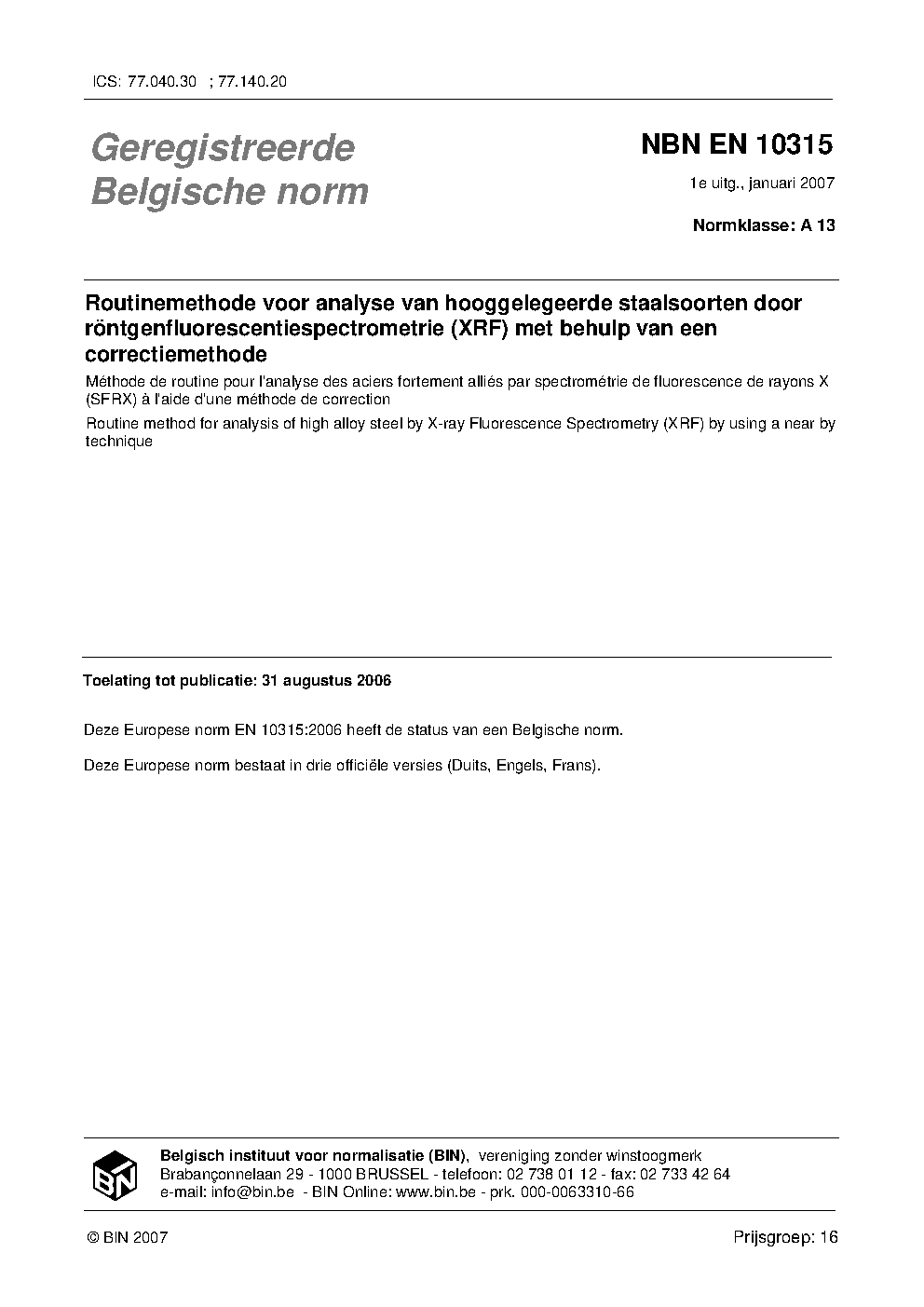
NBN EN 10315:2007
Routine method for analysis of high alloy steel by X-ray Fluorescence Spectrometry (XRF) by using a near by technique
 Preview
Summary
This European Standard specifies a procedure on how to improve the performance of a routine XRF method, already in use for analysis of high alloy steels, by using a ”near by technique”.
The ”near by technique” requires at least one target sample (preferable a CRM) of a similar composition as the unknown sample.
The method is applicable to elements within the concentration ranges according to Table 1:
Table 1 — Concentration ranges
Element Concentration range, % (m/m) a
Si 0,05 to 1,5
Mn 0,05 to 5,0
P 0,005 to 0,035
Cr 10 to 25
Ni 0,1 to 30
Mo 0,1 to 6,5
Cu 0,02 to 1,5
Co 0,015 to 0,30
V 0,015 to 0,15
Ti 0,015 to 0,50
Nb 0,05 to 1,0
a The concentration ranges specified, represents those ranges studied during the precision test. The procedure has the potential to be used outside those ranges but it needs to be validated by each laboratory in every case.
The method is applicable to analysis of either chill-cast or wrought samples having a diameter of at least 25 mm and with a carbon concentration of less than 0,3 % (see NOTE). Other elements should have a concentration below 0,2 %.
NOTE High carbon concentrations, in combination with high Mo and Cr concentrations, could have undesirable structural effects on the sample and could affect the determination of phosphorus and chromium, in particular.
Matrix effects exist between the elements listed. To compensate for those inter-element effects, mathematical corrections shall be applied. A variety of computer programs for corrections is commonly used and included in the software package from the manufacturers.
The ”near by technique” requires at least one target sample (preferable a CRM) of a similar composition as the unknown sample.
The method is applicable to elements within the concentration ranges according to Table 1:
Table 1 — Concentration ranges
Element Concentration range, % (m/m) a
Si 0,05 to 1,5
Mn 0,05 to 5,0
P 0,005 to 0,035
Cr 10 to 25
Ni 0,1 to 30
Mo 0,1 to 6,5
Cu 0,02 to 1,5
Co 0,015 to 0,30
V 0,015 to 0,15
Ti 0,015 to 0,50
Nb 0,05 to 1,0
a The concentration ranges specified, represents those ranges studied during the precision test. The procedure has the potential to be used outside those ranges but it needs to be validated by each laboratory in every case.
The method is applicable to analysis of either chill-cast or wrought samples having a diameter of at least 25 mm and with a carbon concentration of less than 0,3 % (see NOTE). Other elements should have a concentration below 0,2 %.
NOTE High carbon concentrations, in combination with high Mo and Cr concentrations, could have undesirable structural effects on the sample and could affect the determination of phosphorus and chromium, in particular.
Matrix effects exist between the elements listed. To compensate for those inter-element effects, mathematical corrections shall be applied. A variety of computer programs for corrections is commonly used and included in the software package from the manufacturers.
Technical characteristics
| Publisher | Bureau de Normalisation Belge (NBN) |
| Publication Date | 08/31/2006 |
| Cancellation Date | 01/31/2007 |
| Page Count | 29 |
| EAN | --- |
| ISBN | --- |
| Weight (in grams) | --- |
No products.